

Best Heat Resistant Conveyor Belt Vendor from China for Reliable High-Temperature Operations
2026-09-29
If your production line runs hot, you already know that standard belts won’t cut it. The right heat resistant conveyor belt can mean the difference between smooth 24/7 output and unexpected shutdowns. XAN, a trusted vendor from China, specializes in belts built for exactly these high-temperature challenges. Here's a closer look at how they deliver reliability where it matters most.
What Actually Happens to Rubber at 350°C Continuous Exposure
At 350°C, most rubber compounds are pushed far beyond any realistic service limit. Even high-temperature grades like silicone or fluorocarbon rubber begin to suffer catastrophic thermal-oxidative breakdown within hours. The first visible signs are surface microcracks and a rapid darkening that progresses to a charred, brittle crust. Simultaneously, acrid fumes are released as volatile organic fragments boil off, making the environment immediately hazardous without proper ventilation.
Continuous exposure drives random scission of polymer backbones alongside oxidative crosslinking. For a brief window, the material may actually harden due to an initial spike in crosslink density, but this quickly gives way to chain degradation that destroys all elasticity. Mass loss often exceeds 30% by weight, as low-molecular-weight hydrocarbons, carbon monoxide, and decomposition products from fillers and plasticizers escape. The remaining structure becomes a porous, crumbly mass with no mechanical integrity.
In practical terms, rubber at this temperature does not simply age—it disintegrates. Seals shrink, crack, and powder away; any organic content eventually carbonizes, leaving behind only inorganic filler skeletons. There is no meaningful "continuous use" scenario for rubber at 350°C. Applications demanding such conditions must switch to metal, ceramic, or graphite-based materials, because no elastomer can retain function under sustained heat of this magnitude.
Choosing a Carcass That Won't Delaminate When Things Get Hot
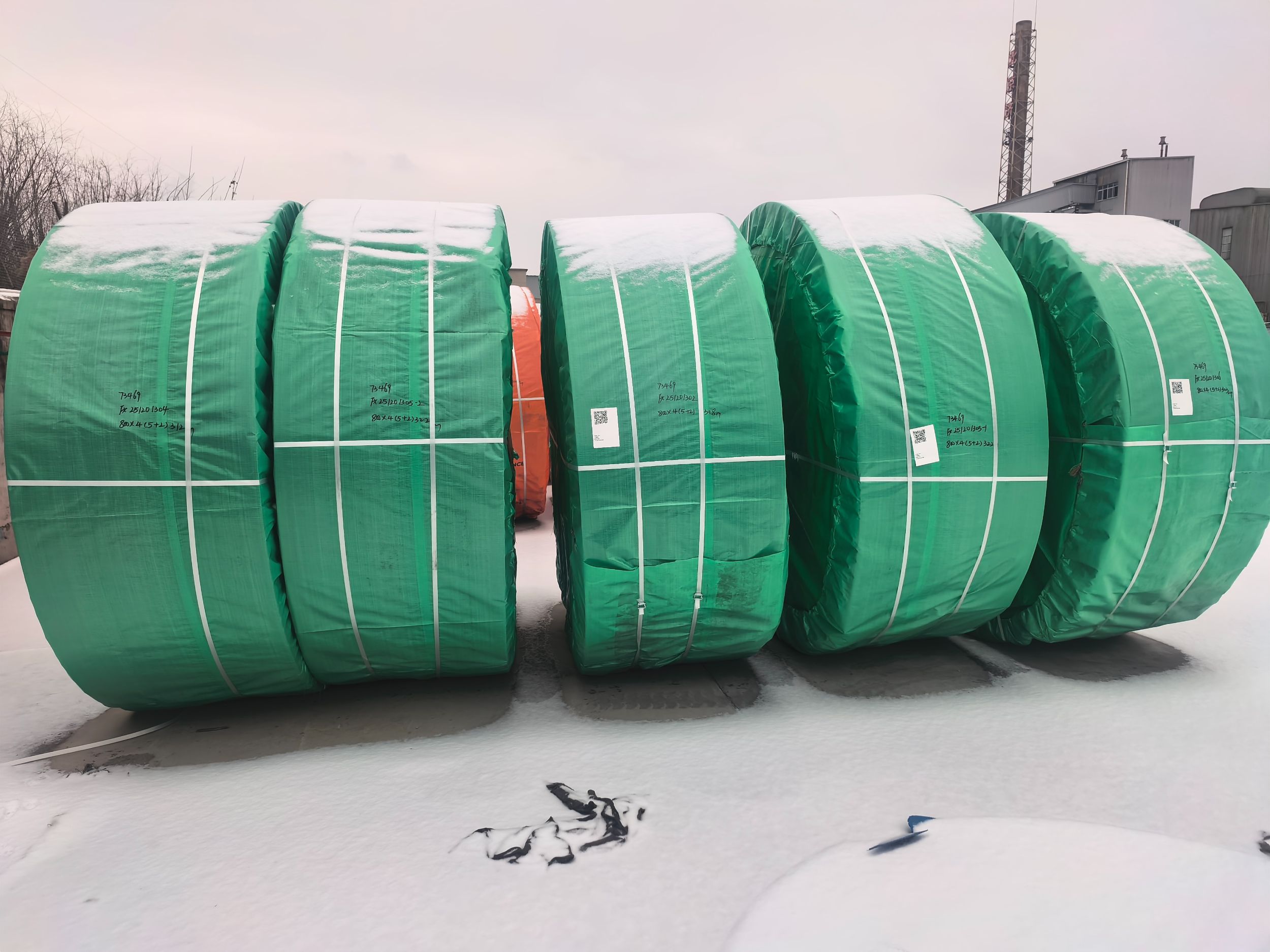
Heat delamination rarely starts with a single bad bond—it usually begins where material expansion rates clash. A carcass built from layers that all swell at slightly different rates under thermal load will quietly work itself apart long before visible cracks appear. Look for manufacturers who publish coefficient of thermal expansion data for each layer, not just a single number for the finished product.
The adhesive layer matters more than most people assume. Resin systems with high glass transition temperatures hold their shear strength when the core gets hot, while cheaper formulations soften and let the fiber layers slide against each other. Ask about Tg ratings and whether the cure cycle included a post-cure ramp above your worst-case service temperature.
Finally, check the edge of the carcass where delamination tends to begin. A properly sealed, slightly rounded edge profile distributes stress instead of concentrating it at a sharp corner. If the manufacturer seems evasive about edge finishing or uses a simple butt joint near high-load zones, that's where heat will find its way in.
The Testing Methods Chinese Factories Use to Predict Belt Lifespan
Walk through the quality lab of any major belt supplier in Zhejiang or Guangdong and you will likely see rows of small electric motors spinning pulley wheels around the clock. These aren't for show. The most common durability test is a simple but relentless fatigue rig: a belt is tensioned at 120% of its rated load and run continuously until visible cracking appears on the ribs or the cord snaps. Technicians log the hours, then compare them against a baseline curve derived from years of field returns. Some factories run as many as thirty rigs simultaneously, each with a different temperature and humidity setting to mimic everything from a dry Saigon warehouse to a humid Brazilian port.
Beyond the endurance rigs, reverse bending tests are used for belts that route around small idler pulleys. A sample length is looped inside out over a tight-radius wheel, then flexed at high frequency. The goal is to force delamination between the rubber backing and the tensile cord. A belt that survives 500,000 reverse flex cycles without separation is considered fit for serpentine applications. Alongside this, ozone chamber testing exposes unstretched belt sections to high ozone concentrations for 72 hours. Since ozone attacks the rubber's unsaturated bonds, any surface microcracks that appear signal poor compound aging resistance long before a real-world failure would show up.
For synchronous and timing belts, factories often use a step-load protocol. The belt runs at low load for a set period, then the load is increased in increments every eight hours while a laser sensor measures tooth deformation. This builds a stress-life curve that helps engineers predict when the tooth will shear under a known overload. Some advanced suppliers have also started installing acoustic emission monitors on their test rigs. The high-frequency sound of rubber tearing can be detected minutes before visible damage appears, allowing the lab to stop the test early and map the exact failure initiation point. These combined methods give Chinese factories a surprisingly precise way to estimate service life without waiting years for field data.
Why Cement Plants in Southeast Asia Are Switching to Chinese Belts
For years, plant managers across Thailand, Vietnam, and Indonesia leaned on European or Japanese conveyor belts as the safe default. They carried a reputation for precision, but that reputation came with a steep price and rigid lead times. Then a quiet shift began on the ground: a maintenance supervisor in a Vietnamese clinker plant noticed that a Chinese-made belt lasted just as long as the premium import under identical heat and load conditions—at roughly 40% lower cost. Word travels fast in industrial parks, and soon procurement teams started calling the same supplier in Shandong.
The real driver, however, is not just upfront pricing. It is the ability to get a custom-width, heat-resistant belt delivered in three weeks instead of four months. Southeast Asian cement lines run hot, dusty, and non-stop, and downtime costs more than any component. Chinese manufacturers have built local warehousing and cut-to-length services near major ports like Laem Chabang and Haiphong, which means a snapped belt on a Tuesday can be replaced by Friday. That kind of responsiveness changes how maintenance budgets are planned.
There is also a pragmatic learning curve. Early adopters shared failure data openly with suppliers, and the feedback loop shortened dramatically. Instead of waiting for an annual catalogue update, plants could request a tweaked rubber compound for higher ambient temperatures or a different carcass weave for sharper trough angles. The result is not a clone of a German belt, but a product shaped by Southeast Asian operating realities—something that feels less like a compromise and more like a better fit.
Heat Resistance Beyond the Cover: Seams, Skirts, and Splices
When evaluating thermal protection systems, the focus often lands on the main covering material. Yet the real failure points frequently hide in the transitions—where panels meet, where edges flare outward, or where separate sections are joined. These zones experience a different kind of stress than the flat surface. Heat doesn't stop at a seam; it finds the path of least resistance, and that path is usually a gap, a stitch line, or a welded splice.
Seams are particularly vulnerable because they interrupt the continuous barrier. Even a small overlap or butt joint can create a micro-chimney effect, pulling hot gases inward. Expansion and contraction add another layer: if the seam material doesn't match the thermal expansion rate of the main cover, repeated heating cycles will slowly tear it apart. Skirts, those outward-flaring edges designed to deflect heat or debris, often suffer from direct flame impingement at an angle that accelerates erosion. The base of a skirt can act like a heat trap, concentrating thermal energy right where the material is thinnest.
Splices present their own set of challenges. Whether done by adhesive bonding, mechanical fastening, or high-temperature stitching, the splice is only as good as its weakest component. A thread that melts at 300°C will compromise a cover rated for 800°C, no matter how robust the main fabric is. Practical solutions involve staggered splices, protective flaps over the joint, or using a sacrificial layer that chars and creates an insulating barrier. The key is treating these transition zones as active design elements rather than afterthoughts—because heat will always test the edges first.
A Practical Checklist for Auditing a Heat-Resistant Belt Supplier
When you step onto the floor of a supplier claiming expertise in heat-resistant belts, the first thing worth checking is not their glossy brochure but the raw material traceability. Ask to see the rubber compound certificates and cross-check batch numbers against the actual rolls in storage. Heat resistance often comes down to the ratio of EPDM, silicone, or specialty polymers, and a supplier who hesitates to show you the formulation data is usually hiding something. Don't settle for verbal assurances that the belt can handle 200°C continuous operation—request third-party test reports from independent labs, and pay attention to the test duration. A belt that survives ten minutes in an oven is not the same as one rated for eight-hour shifts.
Beyond paperwork, watch how the production line handles curing and post-curing stages. Heat-resistant belts rely on precise vulcanization to lock in thermal stability, so look for temperature loggers on the curing presses and ask about their calibration schedule. A practical audit also involves speaking with the quality control team about failure modes they have actually encountered—warping, delamination, or surface cracking—and how they adjusted the process. If they only recite standard compliance clauses, dig deeper: request a sample from the current batch and request you be allowed to run your own thermal cycling test. Suppliers who welcome that kind of scrutiny tend to be the ones whose belts won't fail halfway through a furnace operation.
FAQ
The carcass uses a blend of EPDM rubber and heat-stabilized polyester fabrics, which prevents hardening and cracking even after months of exposure to 200–400°C. The cover compound includes anti-oxidants and a special carbon black dispersion that slows thermal aging far better than standard SBR belts.
Yes. We apply a dual-layer cover design: a tough abrasion-resistant top layer for direct contact with hot abrasive loads, and a heat-insulating bottom layer that protects the carcass from conducted heat. This works well for clinker, sinter, sintered ore, and foundry sand at temperatures up to 400°C for intermittent loads.
Steel mills, cement plants, glass factories, power stations, and chemical processing units are the main users. Any operation moving hot ash, slag, clinker, pellets, or baked sand will see a longer service life compared to general-purpose belts.
We use a two-stage vulcanization process with a special adhesive interlayer between the rubber and fabric plies. Each belt is tested through 50 rapid heating-cooling cycles from room temperature to 250°C before shipment, and we check for ply separation, cover blistering, and edge cracking.
Absolutely. We can produce widths from 400 mm to 2400 mm and any roll length you need. For high-impact or high-temperature edge wear, we offer molded rubber edges or steel breaker plies. You can also choose closed-V or chevron profiles if the material needs to move up steep inclines while hot.
Our standard heat-resistant belts are rated for continuous material temperatures up to 200°C and peak loads up to 400°C. We also have a super heat-resistant series for continuous 250°C and peak 600°C. Each batch is tested in our lab using a hot-plate method that replicates real contact conditions, not just ambient oven aging.
Every shipment includes a detailed splicing manual and a short video guide. If your maintenance team needs live support, we can arrange a video call with our engineers. We also stock common repair patches and edge-sealing compound that can be shipped with the belts to reduce downtime.
For standard heat-resistant belts in common widths, we usually ship within 15–20 days after deposit. Custom widths or special profiles may take 25–35 days. Yes, we can provide A4-sized sample swatches with a small fee that is refundable against your first bulk order.
Conclusion
At 350°C continuous exposure, standard rubber doesn't just soften—it loses elasticity, becomes brittle, and can develop surface cracks that eventually tear into the carcass. The real differentiator among Chinese suppliers isn't the cover compound's lab rating, but how well it resists this progressive hardening without sacrificing adhesion. Leading vendors select polyester or aramid carcasses that maintain dimensional stability at elevated temperatures, preventing the ply separation that plagues cheaper belts when thermal expansion and contraction work against the adhesive layers. To predict actual service life, Chinese factories increasingly rely on accelerated heat aging combined with cyclic flex testing and hot peel adhesion checks, not just the static oven test that many buyers request. This shift toward dynamic simulation gives a more honest estimate of when a belt will fail under real load and high heat.
Cement plants across Southeast Asia have noticed that the best Chinese heat-resistant belts don't just survive—they reduce unplanned downtime because the entire system is considered. Heat resistance has to extend into splice zones, edge sealing, and skirt rubber; otherwise, the cover may hold up while the joint fails or the edge cracks. Top vendors address this by supplying matched splice kits and recommending vulcanization parameters proven at operating temperature, rather than leaving it to the site crew. When auditing a supplier, experienced maintenance managers look beyond the cover thickness and ask for batch-level thermal test reports, a clear list of raw material sources, and references from plants running similar kiln or clinker temperatures. They also visit the factory to see if the mixing line is segregated to prevent contamination between standard and heat-resistant compounds. That level of control, together with willingness to share failure analysis after the sale, separates a reliable long-term partner from a one-time seller.
Contact Us
Contact Person: Anna Lu
Email: [email protected]
Tel/WhatsApp: 8618561668850
Website: https://www.x-conveyor.com