

Best PVC Wall Panel Hot Stamping Foil Manufacturer for Premium Interior Finishes
2026-11-16
Walk into a premium interior and what you notice first is rarely the panel itself—it’s the finish. A woodgrain that catches light just right, a stone texture that reads as intentional, a metallic edge that doesn’t fade. That impression starts long before installation; it starts with hot stamping foil. For projects where generic foil falls short, GUMPTION has built its name as a PVC wall panel hot stamping foil manufacturer focused on consistency, depth, and wear resistance. In this guide, we’ll break down what to look for before choosing your next supplier.
The unsung layer that gives a PVC panel its character
Most people see a PVC panel and register the color, the gloss, maybe the price. What they rarely notice is the thin printed film buried just beneath the clear wear layer. That film carries the grain, the stone flecks, and the odd little shifts in tone that stop the surface from looking like a flat plastic sheet. Without it, a PVC panel is just a white or grey board with an overcoat.
Good decor layers do not simply repeat a pattern every thirty centimeters. They include slight misalignments, softer ink densities, and the occasional knot or mineral streak that the eye catches only at an angle. It is this imperfect, almost accidental quality that gives the panel its character, more like a material that was found than one that was manufactured.
On cheaper panels, this layer is thin and predictable, so the surface reads as a photocopy of wood or stone. On better ones, the layer has enough depth and variation to survive close looking. You may never think about it by name, but it is the reason a room can feel settled rather than fitted out.
Hot stamping foil and the art of controlled reflection
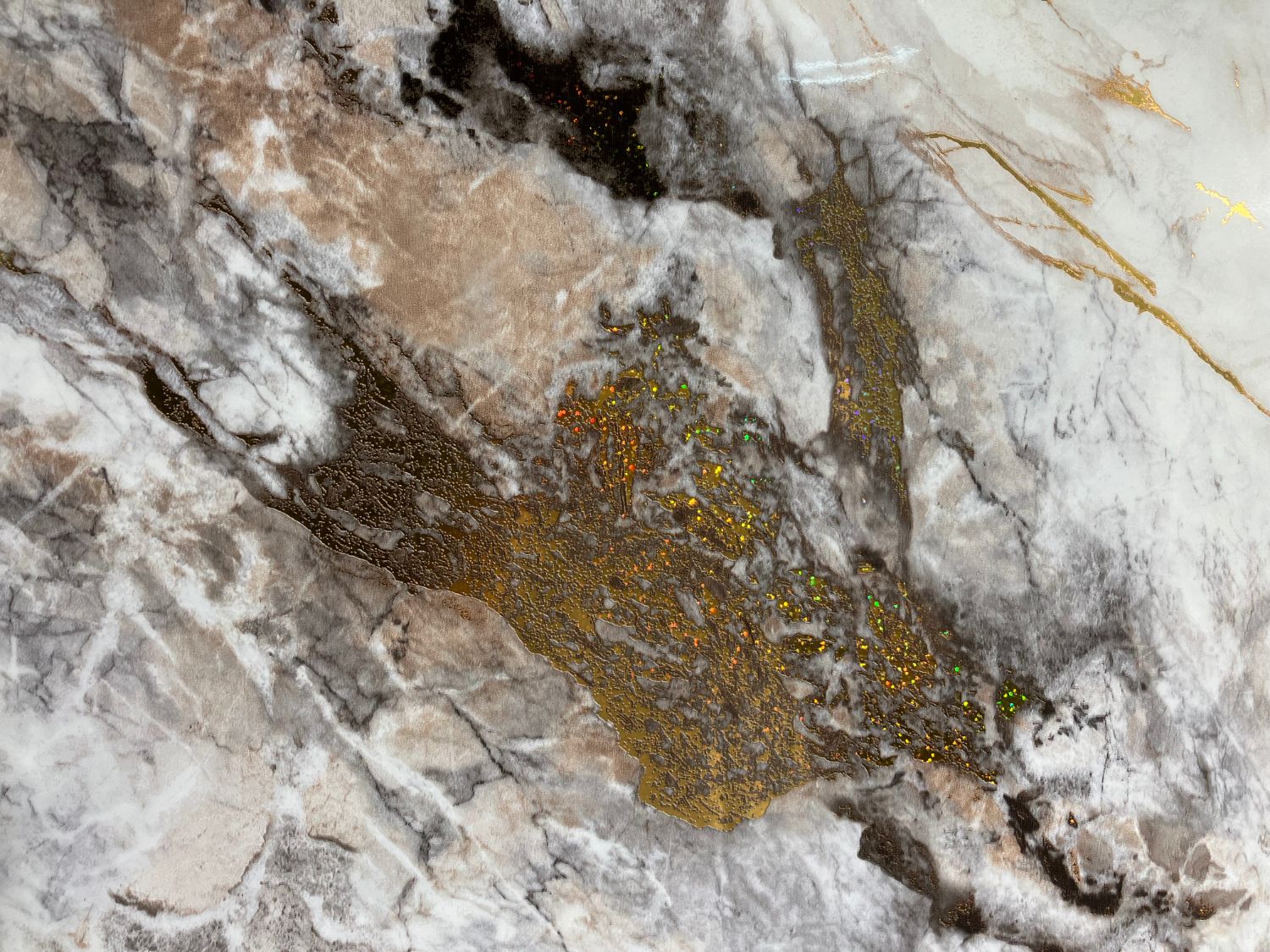
Few materials reward patience quite like hot stamping foil. It sits inert on a roll, a thin skin of color and metal waiting for heat and pressure to wake it. What happens next is less a process than a negotiation: the die meets the foil, the adhesive softens, and the carrier releases its hold. Too little dwell time and the transfer looks starved, edges crumbling into dust. Too much and the foil smears, losing the crisp boundary that gives stamped work its quiet authority. The trick is learning to feel the moment when release becomes inevitable.
Controlled reflection is not about making something shiny. It is about deciding where light may gather and where it must fall away. A fine line of gold across a matte black sheet draws the eye precisely because the contrast has been composed, not left to chance. The foil itself is indifferent—it will mirror anything. The press operator's job is to give that mirror a shape: a serif, a crest, a single unbroken stroke. When it works, the reflection feels less like decoration than like architecture for the eye, a surface with one clear place to land.
Achieving that control requires attention to substrate, temperature, and the age of the foil itself. Humidity changes how paper accepts the adhesive layer. A die cut half a millimeter deeper than the last run will show it in the shoulder of the stamped line. And no two foils behave alike; a pale champagne pigment will tolerate heat differently than a deep crimson with a brushed metal core. The best operators keep notes not as a manual but as a memory of failures and near misses, because consistency in this craft is less about repetition than about reading the room each time the press closes.
What heat, pressure, and timing do to a wall surface
Heat does more than raise the temperature of a wall; it changes how the existing surface behaves before anything new touches it. A brief pass of warm air can relax a painted or vinyl layer just enough to accept a coating without dragging, but lingering heat often pulls old gloss into a cloudy blush or softens the bond holding previous layers in place.
Pressure only matters once that surface has become responsive. Light, even pressure lets a film or coating settle into subtle pores and hairline texture without pushing material aside. Press harder, and the same wall begins to show its limits: matte finishes flatten into shiny compression marks, fresh paint smears under the tool, and trapped air gets driven inward instead of escaping at the edges.
Timing turns those two forces into either a clean result or a slow failure. Work too soon after heating, and the softened surface moves too easily, leaving drag lines and uneven thickness. Wait too long, and the wall has already cooled or the adhesive has begun to lock up, making removal difficult and edges brittle. The same heat and pressure give entirely different outcomes at twenty seconds versus two minutes.
Color decisions that hold up under real interior lighting
A color that looks settled under showroom lights can shift noticeably once it is on your own walls. North-facing rooms tend to pull blues and grays toward a cooler, sometimes flatter cast, while warm afternoon sun can make the same taupe look almost muddy. Rather than trusting a small chip, brush large swatches on two or three walls and watch them over a full day. Compare them near the window, in the darkest corner, and under the lamps you use after sunset. The undertone that emerges under artificial light is often the one you will live with most.
Finish matters as much as the pigment itself. Flat paint softens wall texture but can make deeper tones feel chalky under LED bulbs, whereas eggshell or satin gives the color a slight lift without turning it glossy. In kitchens, baths, or any room with layered lighting, colors that have a muted or earthy base usually stay truer than highly saturated ones. Clean reds, bright yellows, and sharp blues can vibrate or throw unflattering reflections onto nearby surfaces once task lighting hits them.
Also test the color next to the materials already in the room. Wood floors, stone counters, tiles, and even a large sofa all push their own tones back into the walls. A pale green that feels airy on a sample board might pick up yellow from oak or pink from terracotta. If the room lacks strong daylight, favor warm neutrals or dusty shades with enough depth to keep the space from looking hollow. In brighter rooms, cooler and deeper colors tend to hold their character without turning somber.
Durable finishes that don't advertise their toughness
Most surfaces wear their armor on the outside—chunky powder coats, thick rubberized skins, or deliberately scuffed metal that begs to be noticed. The more interesting choices do the opposite. A matte lacquer on oak, a low-sheen urethane on concrete, a tightly woven wool blend on a chair frame: all of them absorb daily friction without turning that resilience into a visual event. You don't read the finish as “tough” because the material itself carries the load. The protection is there, but it behaves like a good editor, invisible until someone spills coffee or drags a bag across the edge.
This quiet durability often comes from pairing two contrary traits: hardness and flexibility. A surface that can take a knock without cracking, then spring back instead of denting, tends to avoid the glossy, brittle look we associate with heavy-duty coatings. The finish saturates the grain or fiber rather than sitting on top of it, so scratches don't appear as white lines against a shiny shell. Over time, the material develops a patina that reads as age, not damage. That's the real giveaway—when a tabletop or armrest looks better after six years of use than it did on day one, the finish has been doing its job without ever raising its voice.
In practical terms, this means looking past the spec sheet's hardness rating and trusting your hands instead. Run a fingernail along the edge. Press into the surface with a thumb and watch how the light moves. Drop a set of keys from three inches. If the finish shrugs it off and leaves no trace, you've found one of the quiet ones. It won't come with a tagline or a demo video. It will simply stay intact, year after year, while louder finishes chip, haze, and demand refinishing. That understatement is its own kind of confidence—one that ages far better than any label promising to be unbreakable.
How to spot a manufacturer's consistency before installation
Instead of relying on a single sample, ask for two or three pieces from different production runs and set them side by side under the same light. Small shifts in edge rounding, coating thickness, or the way a seam meets a corner often show up within minutes. If the parts look like they came from one hand rather than several batches, that is usually a good early sign.
Ask the manufacturer how they track tool wear and when they recalibrate cutting or forming equipment. A shop that cannot point to maintenance intervals or lot records will often tell you more through hesitation than through a direct answer. Consistent output rarely comes from occasional inspection; it comes from routine checks that happen even when no customer is watching.
Request retained samples or photos from the line at different dates, not polished marketing pieces. Look at the same detail each time: a threaded hole, a weld start, a folded corner, the way a finish breaks over an edge. Minor variation is normal, but if the character of the part changes from batch to batch, that inconsistency will likely follow the product into installation.
FAQ
Check the release layer temperature range, because PVC softens at lower heat than many other substrates. A foil designed for PVC should transfer cleanly at moderate roller temperatures without shrinking or glossing the panel surface. Also ask for humidity resistance data and a retained color sample from the supplier.
Yes, we engrave our embossing rollers at 300 lines per inch where needed, so even narrow grain ticks and woven thread patterns stay readable. The foil pigment layer is thin enough to follow the texture instead of bridging it, which keeps dark grout lines and pale highlights crisp.
It holds up well. Our standard top coat passes a 5,000-cycle scrub test with a soft brush and neutral cleaner, and the metallic layer is sealed against oxidation. For lift lobbies, retail walls, and hotel corridors, we usually recommend the matte or anti-fingerprint finish to reduce visible wear.
We do. Gloss levels range from a 3% dead-matte to an 85% high-gloss, and we can apply a soft-touch or anti-fingerprint overcoat. Many designers choose the 10% satin for premium wall panels because it reduces glare while still showing the texture depth.
A typical custom project takes three to four weeks: one week for lab draws and color matching, one week for engraving and pilot sampling, and ten to fourteen days for full production after approval. Rush service is possible if the engraving file is already prepared.
The foil is suited to flat boards, routed 3D panels, V-groove planks, and tongue-and-groove wall systems. We adjust the adhesive and release layers slightly depending on whether the panel is foamed or solid, and whether the surface is smooth or lightly textured.
Every production batch is measured with a spectrophotometer and compared to a master standard under D65 lighting. We also store a retained sample of each batch for two years. If a repeat order drifts beyond a Delta E of 0.8, we stop and correct the tint before shipping.
Conclusion
Most conversations about PVC wall panels stop at the visible surface, but the layer that actually gives a panel its depth is often the one nobody names. Hot stamping foil sits between utilitarian PVC and a genuinely premium interior finish, shifting how light lands on a wall without turning it into a mirror. The better manufacturers treat this as a controlled optical decision rather than a decorative afterthought. They know that subtle reflectance has to survive heat and pressure in production, and that timing determines whether the foil fuses cleanly or leaves a faint haze. When those variables are managed well, the result is a surface that reads as material, not laminate.
Color choices matter most under real interior lighting, not on a sample board. A deep charcoal or warm greige has to hold its tone across morning and evening light without looking flat or synthetic. The strongest finishes are also the quietest: they resist scuffs, cleaning products, and daily contact without a glossy, plastic-like announcement of toughness. Before installation, consistency becomes the honest test. A reliable manufacturer shows repeatable edge definition, even tone, and stable release across batches, not just a single impressive sample. That consistency is what separates a panel that looks premium on day one from one that still does years later.
Contact Us
Contact Person: Hsien
Email: [email protected]
Tel/WhatsApp: +86 57387072688
Website: https://www.gsfilm.cn