

Best Shearing Machine Solutions from China for Precision Metal Fabrication
2026-10-18
When precision metal fabrication demands clean, burr-free cuts, Chinese shearing machine manufacturers have raised the bar—and JIAN MENG sits at the forefront. But with so many options claiming "best," how do you identify the solution that actually holds tolerance on every stroke? This guide cuts through the noise, unpacking what true precision means in plate shearing and why JIAN MENG's engineering choices make a measurable difference on the shop floor.
What Really Determines Straightness in a Sheared Edge
Straightness in a sheared edge is rarely governed by a single variable. The clearance between the punch and die, typically set as a percentage of material thickness, has an outsized effect: too tight a gap produces secondary shear zones that drag the edge into a slight bow, while excessive clearance lets the material roll and tear before the final fracture, leaving a wavy profile. Material hardness and yield strength introduce additional variation, since harder alloys resist the plastic bending that occurs just ahead of the cutting line, often yielding a flatter cut but with a sharper burr side.
Beyond the tooling setup, the shear angle and blade sharpness quietly determine how stress concentrates at the cut front. A worn edge smears rather than separates the metal, causing the fracture path to wander and directly pulling the edge out of line. Similarly, an uneven shear angle—common on long guillotine blades—loads one end of the sheet before the other, so the advancing crack does not meet the free edge at a consistent depth, and the resulting strip can curve laterally. These effects compound when internal residual stresses from prior rolling or leveling are not uniform across the sheet width.
In practice, the straightest sheared edges come from matching clearance to the specific alloy and temper, keeping the die face and punch edge in good condition, and using rake angles that spread the cutting force evenly across the part. Operators who chase straightness by trial and error often overlook that the incoming material's stress state already sets a baseline—before the blade even touches, the sheet may hold enough locked-in stress to pull the edge sideways after separation. Controlling those upstream conditions, together with a stable shear gap, matters more than increasing clamping force or slowing the ram speed.
Why Cheap Blades Cost More in High-Volume Precision Work
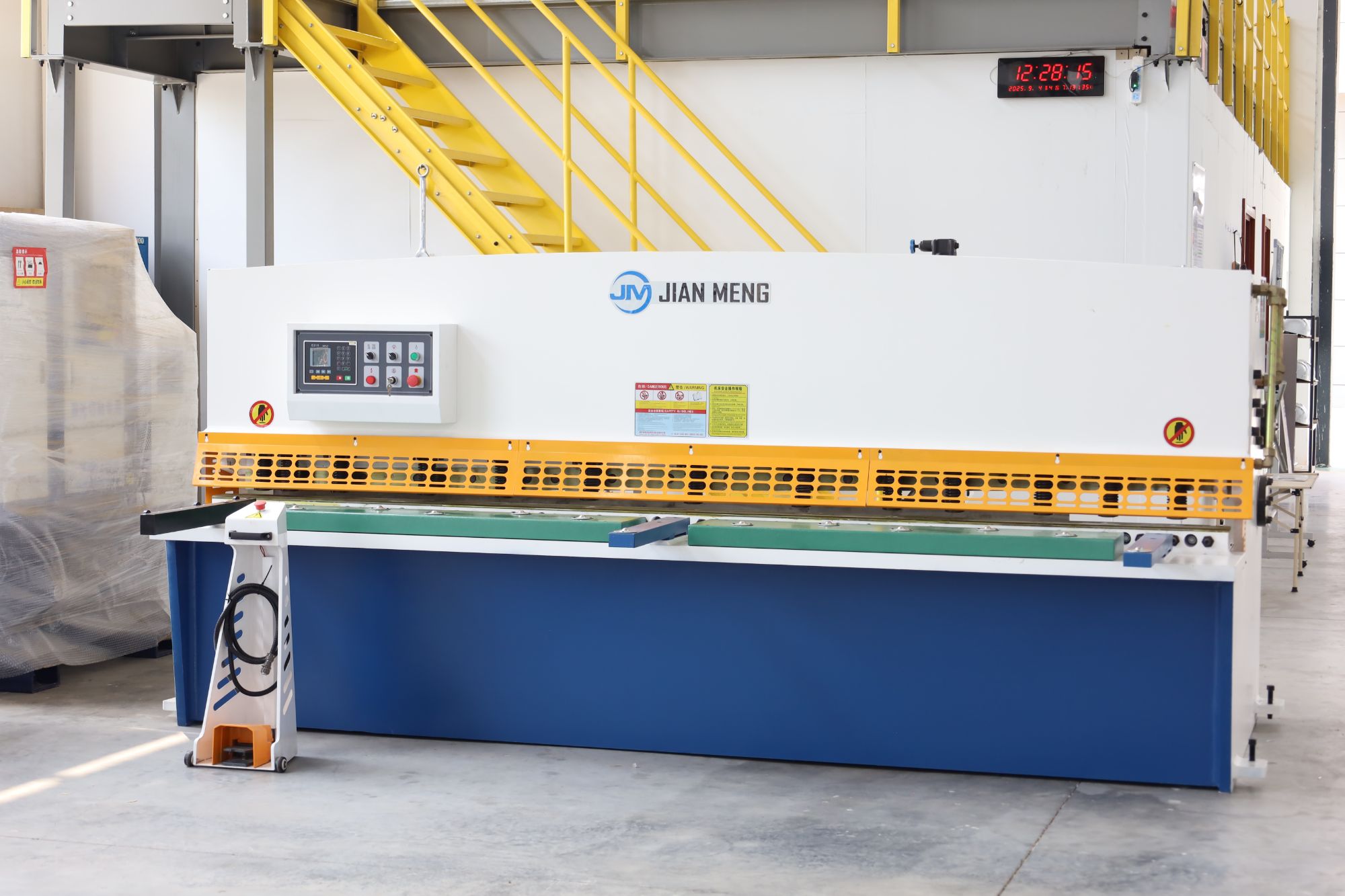
In high-volume precision cutting, an inexpensive blade often drifts out of tolerance within the first few hundred cycles. The edge rolls or chips slightly, forcing operators to slow the feed rate or accept a higher rejection rate. What looks like a saving on the invoice becomes a recurring line item in rework, scrap, and machine downtime.
A budget blade's metallurgy is usually the culprit. Cheaper alloys and rushed heat treatment leave uneven hardness across the edge, so one part may cut clean while the next tears or deforms. In precision work, that inconsistency means more frequent QC checks and more manual intervention, which eats into any upfront discount.
Over a full production run, the math flips. Premium blades hold their geometry longer, need fewer adjustments, and produce fewer out-of-spec parts. When you factor in labor hours, wasted material, and lost throughput, the cheaper option ends up costing several times more per usable part.
Sizing a Shear for Stainless and Mild Steel Without the Usual Guesswork
The core number most shops miss is shear strength, not thickness. Mild steel typically shears at 35,000–45,000 psi, while 304 stainless runs 50,000–60,000 psi and work hardens fast. So a machine rated for 1/4-inch mild steel won't cut 1/4-inch stainless without overloading the frame or chipping blades. Start with the force equation: tons = (cut length × thickness × shear strength) / 2,000. Then compare that with the shear's rated tonnage at full length. If you can't find shear strength for your exact alloy, use 50,000 psi for stainless and 40,000 psi for mild as safe midpoints.
Blade clearance matters as much as tonnage. Stainless wants a tighter gap than mild steel of the same thickness; too loose and the edge rolls, too tight and you'll gall the blade faces. As a starting point, set clearance to about 5–8% of material thickness for stainless, against 8–12% for mild. Then run a test strip at full length before committing to the whole sheet. If the offcut shows a clean vertical burnish zone and a narrow fracture line, the shear is dialed in. If it tears or leaves a heavy burr, adjust clearance before blaming the machine capacity.
Rake angle and cutting length also affect sizing. A lower rake angle reduces distortion but raises peak load; a higher rake spreads the cut over a longer stroke, lowering force but twisting the drop piece. For stainless wider than 48 inches, consider a shear with a two- or three-degree variable rake and add at least 20% reserve capacity beyond the calculated tonnage. That reserve handles batch-to-batch hardness variation and blade dulling between regrinds—both of which are far more common on stainless orders.
How Chinese Builders Rethink Frame Rigidity for Cleaner Cuts
Inside many cutting-equipment workshops across southern China, the machine frame is no longer treated as a passive skeleton. Engineers now map stress flow through the entire structure before adding a single rib, removing material from low-load zones and reinforcing only the paths that actually flex under high-speed tool pressure. The result is a lighter frame that vibrates less, not more, because stiffness is placed where it changes cut quality instead of being spread evenly as dead weight.
A growing number of builders are moving away from the idea that thicker steel always means better damping. Some teams now pour mineral castings around steel cores, pairing the rigidity of metal with the vibration-absorbing character of polymer concrete. This lets the frame swallow different frequency bands before they reach the cutting edge, so the tool no longer chatters through curves or leaves ripple marks on the finished edge.
Assembly methods have shifted too. Rather than relying on post-weld stress relief alone, builders now use staged preloading and laser interferometer checks to keep the frame flat under real working loads. Clean cuts come less from a sharper blade and more from a frame that holds its geometry while the workpiece and tool push against each other, turning rigidity into a controllable variable instead of a fixed spec.
Automation Add-Ons Worth Paying For and Ones You Can Skip
Some automation add-ons genuinely earn their price by fixing the messy edges of free tiers. Advanced error handling and retry logic, for instance, keeps a broken webhook from silently killing a whole workflow at 3 a.m. Conditional branching that actually respects multiple 'if this, then that' paths is another one worth paying for—it turns a brittle one-size-fits-all routine into something that adapts to real customer behavior. If an add-on lets you connect to a legacy CRM or ERP without duct tape and custom scripts, that monthly fee usually pays for itself in saved debugging time.
What you can usually skip: anything that just reskins a built-in feature and calls itself 'premium.' A lot of dashboard upgrades fall into this trap—they add a dark mode and a few extra charts but don’t change what the data tells you. Basic social media auto-schedulers are another common skip, since native tools or even a simple calendar reminder often handle the same job without another subscription. Also be wary of add-ons that promise 'predictive insights' but only count rows and call it analysis; if the output looks like something you could get from a pivot table, you’re paying for the marketing, not the function.
The real test is whether the add-on removes a recurring manual action or prevents a recurring failure. If you can name the specific hour of your week it saves or the exact error it stops, it’s likely worth the cost. If the only selling point is 'everything in one place,' skip it and keep your automation stack lean—extra subscriptions have a way of becoming their own maintenance burden.
Acceptance Testing Proving Machine Accuracy Before It Ships
Acceptance testing is where the paper spec meets the shop floor. A builder can quote repeatability numbers all day, but after a machine is leveled, wired, and warmed up, the only way to know it actually holds those tolerances is to measure it. Laser interferometry on each linear axis checks positioning and repeatability against the contract values. Ball bar tests catch squareness and backlash issues that don't show up in a single-axis laser run. These numbers matter because a small yaw error at the spindle can turn into a much larger positional error at the tool tip.
Cutting trials add another layer of proof that static measurements miss. Machining a standard test piece, such as an ISO 10791-7 or NAS 979 part, forces the machine to interpolate multiple axes under real cutting loads and spindle heat. The resulting bores, faces, and profiles are then inspected on a CMM. If roundness, perpendicularity, and surface finish all fall within the agreed limits, the machine has demonstrated it can do the job it was bought for—not just move a table back and forth in a climate-controlled lab. Recording these acceptance results also gives the maintenance team a clear baseline for future drift checks.
FAQ
Precision models typically include adjustable blade clearance, a rigid frame to reduce deflection, and a backgauge with fine incremental control. Those features keep cuts square and burr-free even on 0.5 mm stock.
Instead of focusing on brand names, look for factories with in-house testing labs, ISO 9001 certification, and a track record of exporting to demanding markets. Request video of the machine cutting your exact material thickness before committing.
Very important. A good CNC-controlled backgauge and stroke adjustment let operators store multiple job recipes and switch between them without re-measuring. That cuts setup time and keeps part dimensions consistent across batches.
Not always. Guillotine designs move the blade vertically with less rake angle change during the cut, which often produces straighter edges on thicker plates. Swing beam machines are lighter and cheaper but may struggle with very precise angle tolerances.
Look for blades made from Cr12MoV, 6CrW2Si, or similar tool steel, hardened to HRC 52-58. Some suppliers offer optional nitriding or laser cladding on the cutting edge. That extends sharpening intervals especially when cutting stainless steel.
Yes, many factories offer integration packages with pneumatic sheet supports, front and side gauges, and conveyor systems. If you plan to add robotic loading later, confirm that the control interface supports standard communication protocols like Modbus or Ethernet/IP.
Ask about the frame welding process and stress relief. A machine that is welded and then annealed in a furnace will hold blade alignment far longer than one that is merely bolted together. Also check the thickness of the side plates and the distance between guide rails.
Work with a supplier who provides complete shipping documentation, including the commercial invoice, packing list, and bill of lading. Ask about voltage and frequency compatibility for your country, and whether a local technician can assist with commissioning and training.
Conclusion
Straightness in a sheared edge rarely gets the attention it deserves until a batch of parts comes out with a visible bow. What actually controls that straightness is the frame's resistance to deflection and the precision of the ram guidance. A number of Chinese manufacturers have started investing in thicker, stress-relieved weldments and machined guideways instead of simply copying older designs. That change matters because even slight frame twist under load shows up as edge taper or curvature. Blade choice is just as critical. Low-cost blades with inconsistent heat treatment may seem like a saving, but in high-volume stainless work they dull rapidly, trigger more frequent changes, and end up costing more in downtime than a properly specified premium blade.
Sizing a shear for both stainless and mild steel means knowing that rated capacity is not a universal number. Mild steel can often be processed close to the machine's nominal rating, while stainless requires a healthy margin because it work-hardens and carries higher tensile strength. If you ignore that, a machine that easily handles 6 mm mild steel may fight you on 4 mm stainless. Automation should be chosen with a clear payback in mind. A powered backgauge and pneumatic sheet supports earn their cost quickly in a busy shop, but sophisticated CNC front gauging often sits unused. Before shipping, ask the builder to run acceptance tests using your own material and inspect the cut edge for straightness, burr, and repeatability. That test run tells you more than any specification sheet.
Contact Us
Contact Person: Jeanie
Email: [email protected]
Tel/WhatsApp: +86 19805122954
Website: https://www.jianmeng.com