

Boron Carbide Ceramic Company Drives Innovation in Lightweight Armor and Wear-Resistant Solutions
2026-09-12
Lightweight armor that stops threats without weighing down the wearer—and components that shrug off relentless abrasion. These are the promises of advanced boron carbide ceramics, and few companies are delivering on them like HUAYI TECH. As a specialist in this ultra-hard material, the company is quietly pushing the limits of what protective and wear-resistant solutions can achieve, sparking curiosity among engineers and defense leaders alike.
Cutting Armor Weight Without Sacrificing Stopping Power
Traditional armor often relied on sheer mass to stop projectiles, but that approach is fading. Modern designs use a hardness gradient: a thin ceramic strike face shatters the incoming round, while a composite backing of ultra-high-molecular-weight polyethylene or aramid fibers catches the fragments. By tuning the ceramic tile size and adhesive layer, engineers can cut areal density by 30–40% compared to rolled homogeneous steel, all while maintaining the same V50 ballistic limit.
Weight reduction also comes from internal architecture, not just material swaps. Honeycomb or lattice cores sandwiched between thin face sheets remove dead mass from non-load-bearing zones and disrupt stress wave propagation. In some composite armors, the core’s cell geometry causes an armor-piercing core to yaw or fracture after the first layer, dramatically reducing the energy that reaches the backing plate. This lets designers shave kilograms without shrinking the protected area.
Emerging processes like additive manufacturing push this further. Laser-sintered metal-ceramic gradients can place high-density material only where a threat is most likely to hit, leaving surrounding regions porous and light. Similarly, shear-thickening fluid embedded in fabric remains flexible under normal handling but stiffens instantly on impact, adding negligible static weight yet measurably improving multi-hit performance. These techniques shift the conversation from “how heavy must it be?” to “how smartly can it fail?”
Why Boron Carbide Outperforms Standard Ceramics in High-Velocity Impacts
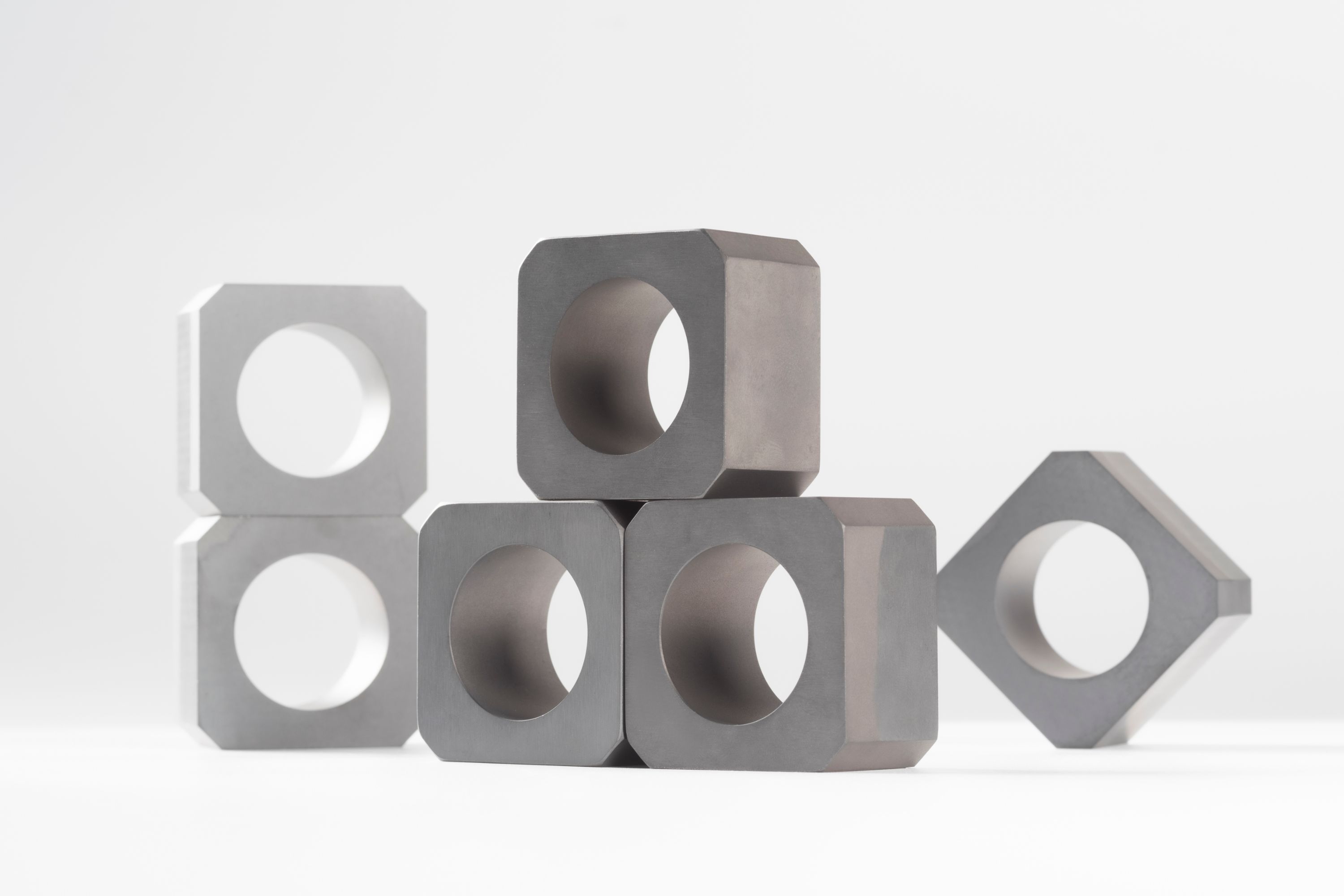
At the instant a projectile strikes, most ceramics fail through microcracking that spreads from the impact point. Boron carbide resists this differently. Its combination of extremely high hardness (second only to diamond and cubic boron nitride) and low density means the shock wave travels faster and decays more quickly, confining damage to a smaller volume. Standard alumina or silicon carbide, by contrast, tends to shatter along grain boundaries, creating a wider fracture network that weakens the armor after the first hit.
Another overlooked factor is boron carbide's unusually high Hugoniot elastic limit. Under high-velocity loading, it can store more elastic energy before transitioning to plastic flow, so the projectile's kinetic energy is converted into a spreading elastic wave rather than immediate localized failure. The ceramic also has a much higher sound speed than most standard ceramics, which allows stress to dissipate over a larger area, preventing the catastrophic penetration seen with lower-performance materials.
Practical testing shows that even with similar areal densities, boron carbide panels stop high-velocity rifle threats with less back-face deformation than alumina or silicon carbide. This is not simply a matter of hardness; it's the tight interlocking of boron and carbon atoms in the rhombohedral lattice, which resists dislocation motion at the strain rates typical of ballistic impacts. Standard ceramics, with their ionic or covalent-ionic bonding, cannot match this combination of low mass, high stiffness, and damage tolerance.
Wear Liners Built for Abrasive Slurries and Heavy Impact Zones
Mines and mineral processing plants often see ordinary liner materials chewed through in a matter of weeks. The combination of fast-moving abrasive slurries and sudden rock impacts creates two very different failure modes: fine-particle erosion and large-scale fracture. A liner that handles one rarely survives the other.
The most effective designs pair a wear-resistant face—usually ceramic, high-chrome white iron, or hardened polyurethane—with an energy-absorbing backing. In zones where coarse ore drops from height, the liner thickness is stepped up or the backing is made from a resilient rubber that spreads the impact load and prevents cracking behind the hard face.
Matching the liner to the actual slurry conditions matters more than choosing the hardest material available. Slurry velocity, particle size distribution, and impact angle all change how the surface wears. Custom-molded panels with varying thickness across a single piece can extend replacement intervals significantly, cutting downtime in chutes, transfer points, and mill discharge areas.
Precision Sintering That Turns Fine Powder into Multi-Hit Armor Systems
Precision sintering does more than bind fine powder into a solid shape. It controls particle necking, densification, and grain growth at every stage, eliminating the microscopic voids that usually become crack initiation sites. The result is a ceramic plate with such uniform density that an incoming projectile meets the same resistance across the entire strike face. For multi-hit armor, that uniformity is everything: a single weak point turns a second round into a catastrophic failure.
Instead of shattering on first impact, a well-sintered tile fractures only at the immediate contact zone while the surrounding material stays intact. The fine starting powder allows extremely tight control over final grain size, which fine-tunes the balance between hardness and fracture toughness. This means the armor can blunt, deflect, or erode multiple penetrators in quick succession without losing its protective geometry.
The manufacturing side benefits as well. Near-net-shape sintering reduces the need for heavy post-processing, so each tile retains the precise dimensional tolerances required for tight armor arrays. Batch-to-batch consistency holds up because the process parameters—temperature ramp, dwell time, atmosphere—are locked to the powder's specific surface area and composition. That repeatability is what makes precision-sintered multi-hit armor practical outside the lab.
From Ballistic Shields to Mining Chutes: One Material, Two Very Different Jobs
Few materials can claim to stop a bullet in the morning and guide abrasive slurry down a chute by afternoon. Yet that's exactly the kind of versatility offered by certain advanced ceramics and wear-resistant alloys. In one setting, they form the backbone of a ballistic shield, absorbing and dispersing high-velocity impacts while remaining light enough to carry. In another, they line the interior of a mining chute, shrugging off the constant scrape and gouge of rock, ore, and dust hour after hour. The shared trick isn't magic—it's a careful balance of hardness, toughness, and microstructural design that lets the same base material adapt to jobs that seem worlds apart.
What makes this crossover possible is the way manufacturers tune the material's properties without changing its fundamental nature. For ballistic protection, they might emphasize crack deflection and energy absorption, using thinner, layered sheets or ceramic tiles backed by composite fabrics. For mining chutes, the priority shifts to pure abrasion resistance and long-term dimensional stability, so the material is often cast into thicker, replaceable liners. Both applications demand resistance to wear and impact, but the specific failure modes differ: a shield must survive a single catastrophic event, while a chute liner must endure millions of small, relentless contacts. The same atomic bonds that resist deformation under a bullet's point load also refuse to yield easily to the scouring action of silica particles.
The result is a quiet but profound efficiency. Instead of maintaining separate supply chains and testing protocols for each job, engineers can draw on one well-understood material family, tweaking composition and processing to match the threat. A mining operation in Chile and a tactical gear manufacturer in Texas might buy from the same ceramic foundry, each confident that the material's core reliability is already proven. This dual life isn't a compromise—it's a testament to how a single material, when understood deeply, can excel in roles that demand almost opposite extremes of performance.
What Consistent Ceramic Density Means for Reliability in the Field
A ceramic part with uniform density behaves predictably under stress. When pores or density gradients are present, cracks tend to initiate at the weakest point, often where the material is slightly less compacted. In field conditions—vibration, thermal cycling, mechanical load—those micro-defects become failure sites. Consistent density removes that lottery, giving every region of the component the same baseline resistance to fracture and wear.
Reliability is rarely about the average property; it's about the minimum property. Two ceramics can share the same nominal density, yet one may fail early because a small zone sits at 94% of theoretical while the rest is at 98%. Field failures cluster around those outliers. Tight density control across the entire part means the designer can trust the lowest-performing volume, not just the spec sheet average. That margin is what keeps a sensor housing intact after years of thermal shock or a seal face flat after millions of cycles.
Manufacturers often quote density as a single number, but what matters in the field is the spread. A narrow density distribution—verified by cross-sectional sampling or CT scanning—translates to consistent dielectric strength, consistent thermal conductivity, and consistent hardness. Engineers who have chased intermittent failures in deployed equipment learn to ask not just "what density?" but "how uniform?" The answer usually separates components that survive the first season from those that run a decade without a single field return.
FAQ
Boron carbide offers an exceptional hardness-to-weight ratio. With a density around 2.52 grams per cubic centimeter, it is significantly lighter than alumina or silicon carbide, yet it stops high-velocity projectiles effectively. That combination lets armor designers cut weight without sacrificing protection, which matters a great deal in body armor and vehicle plating.
Instead of simply marketing standard boron carbide parts, the company tailors grain size, sintering aids, and post-processing to each wear environment. For instance, sandblasting nozzles get a fine-grained microstructure to resist erosion, while pump seals get a polished surface to reduce friction. This customization is what separates their products from off-the-shelf ceramics.
Defense and security are obvious beneficiaries, but the reach goes further. Mining operations use boron carbide liners in chutes and cyclones, nuclear plants rely on it for neutron absorption, and aerospace firms specify it for lightweight armor panels. The company also supplies components for waterjet cutting systems where precision and longevity are critical.
Boron carbide is notoriously difficult to densify because of its strong covalent bonds and low self-diffusion. The company uses pressure-assisted sintering and carefully controlled atmosphere profiles to reach near-theoretical density without excessive grain growth. They also machine parts with diamond tooling to achieve tight tolerances, which many competitors avoid due to cost.
One notable development is a hybrid armor tile that fuses a thin boron carbide strike face with a polymer backing. This design reduces weight by roughly 15 percent compared to monolithic tiles while maintaining the same ballistic rating. It emerged from a collaboration with a European defense contractor and is now being tested for helicopter seat armor.
They rely on a closed-loop production process where every powder lot is characterized before mixing, and each sintered billet undergoes ultrasonic scanning and X-ray diffraction. If a batch deviates in hardness or fracture toughness beyond a narrow band, it is pulled for root-cause analysis. This rigor is why armor manufacturers trust their supply.
Boron carbide is one of the few materials with a high neutron absorption cross-section, thanks to the boron-10 isotope. The company supplies control rods and shielding pellets to nuclear facilities. Recent work focuses on enriched boron carbide to improve efficiency in compact reactor designs, which could shrink shielding requirements.
For less demanding wear applications, the company offers a reaction-bonded boron carbide composite that costs about 40 percent less than fully dense sintered grade. It retains most of the hardness and wear resistance but sacrifices some ballistic performance. This tiered product line lets customers choose what they actually need instead of paying for over-engineering.
Conclusion
Boron carbide has become the material of choice where every kilogram counts and stopping power cannot be compromised. Through precision sintering, the company converts fine boron carbide powder into dense ceramic tiles that shed rifle rounds without the weight penalty of steel or standard alumina. In high-velocity impacts, the carbide's extreme hardness fractures and erodes projectiles instead of allowing deep penetration, which means multi-hit armor systems remain intact after repeated strikes. That balance of low density and high compressive strength is what lets designers cut armor weight while keeping the same protective envelope. That is why it keeps showing up in next-generation body armor and vehicle platforms.
The same material behaves very differently when it leaves the armor lab and enters a mining chute or slurry line. Here, consistent ceramic density is what prevents unpredictable failures: uniform grain structure across a wear liner means abrasive slurries and heavy impact zones wear the surface evenly rather than chipping out weak spots. This reliability translates into longer replacement intervals compared with conventional steel liners. Whether formed into a ballistic shield or a chute liner, boron carbide proves that one advanced ceramic can handle two extremely demanding jobs—stopping high-velocity threats and surviving relentless abrasion—without changing its fundamental advantage. Operators get fewer shutdowns and better uptime.
Contact Us
Contact Person: Junting Leo
Email: [email protected]
Tel/WhatsApp: +86 18615009766
Website: https://www.huayimaterial-china.com/