

Corrugated Box Solutions That Keep Products Safe in Transit
2026-11-16
Every shipment tells a story long before the buyer opens the carton—a story of conveyor belts, stacked pallets, and unpredictable weather. If your packaging is not built for that journey, the product pays the price. That is why corrugated box design should be treated as a quiet competitive advantage, not an afterthought. At Imagine Craft Packaging, transit protection is about more than thicker walls; it is about matching board grades, flute profiles, and structural folds to the realities of handling. In this guide, we explore corrugated box solutions that keep products intact from warehouse to doorstep without overpacking or inflating freight costs.
Flute Collapse as the First Line of Defense Against Drops
Most people assume a damaged box means packaging failed. With corrugated board, a crushed flute often means it worked. The flutes are vertical paper arches between the liners; when a package hits the ground, those arches at the impact point buckle first. They convert downward energy into folding, tearing, and heat, so less of that force reaches the product.
Think of flute collapse as a tiny, paper version of a car crumple zone. It is not designed to stay rigid; it is designed to give way in a controlled pattern. The board's outer liner may dent or crease while the inner product stays untouched. That local flattening actually lengthens the impact duration by milliseconds, which lowers peak force.
The catch is that collapse only protects once. After a serious drop, the flutes in that area are spent. If the same carton lands on the same corner again, there is no more give left and the product absorbs the blow. That is why a package that looks only slightly bruised after one fall should not be trusted to survive another.
Edge Crush in a Real Trailer When Stacking Strength Actually Counts
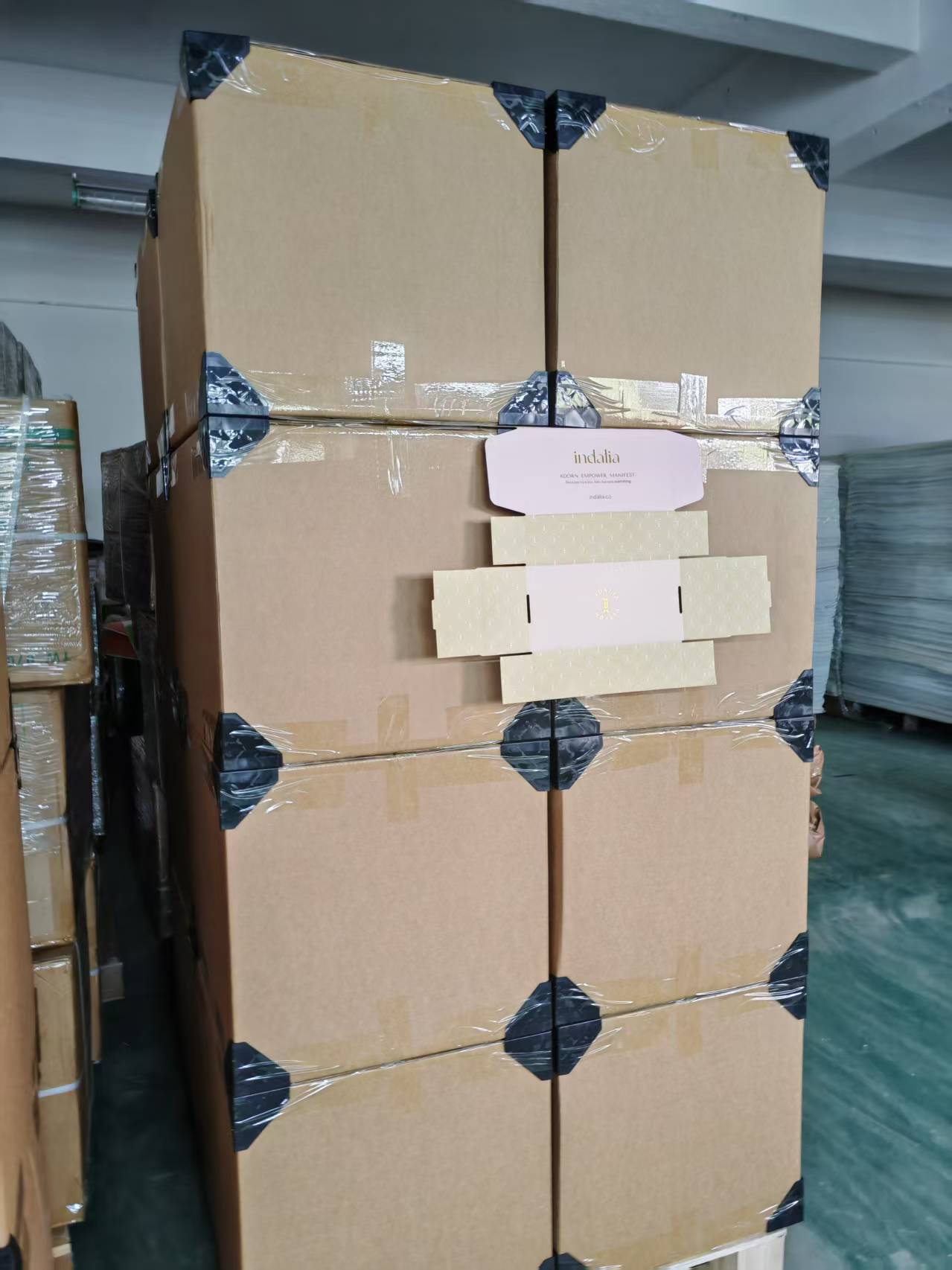
Lab numbers give a starting point, but a real trailer doesn’t care about a 32 ECT rating if the bottom box is sitting on a forklift scuff or half an inch of pallet overhang. The load path gets messy fast: deck boards flex, pallets aren’t perfectly flat, and stacked boxes settle as the trailer rolls. That’s where edge crush stops being a spec and starts being the difference between a carton that holds the lane and one that folds inward by the second loading dock.
Stack height matters more than people admit. Three high might look fine in a warehouse aisle, but in transit the bottom position takes static weight plus repeated shock from uneven pavement and hard braking. If the flutes are even slightly out of alignment or the box was underfilled, the vertical corners become the only thing carrying the load. Once one corner starts to bow, the failure travels upward and sideways, usually into the pallet next to it.
Practical checks before dispatch help more than chasing a higher ECT on paper. Make sure the bottom cartons sit fully on the pallet boards, keep the heaviest boxes in the lowest position, and walk the trailer floor for nails or broken boards that concentrate pressure. In a real trailer, stacking strength is less about the number on a certificate and more about how cleanly that vertical column of boxes can transfer weight straight down to the deck.
Die-Cut Inserts That Lock Odd-Shaped Parts in Place
Odd-shaped parts rarely sit still on their own. A cast housing with a protruding flange, a curved manifold, or a sensor with an offset connector will shift, rub, and eventually arrive with scuffed threads or cracked fittings. Closed-cell polyethylene foam, cut to the exact silhouette, removes that slack. The part drops into a cavity that mirrors every irregular contour, so the high points take the pressure while recessed areas stay suspended and protected.
These inserts do more than fill empty space. When the cavity is slightly undersized along key edges, the foam grips the part without needing straps, tape, or extra layers. That locking effect keeps weight balanced inside the case or crate, even when the package is tipped or jostled during loading. It also makes packing faster, since there is no guesswork about which side faces up or how many pads are needed.
Modern Barrier Coatings That Keep Water Out Without Wax
Wax has always been a short-term answer: it sits on the surface, looks good for a few washes, then disappears. Modern barrier coatings work differently by bonding directly with the substrate. The result is a thin, tightly adhered layer that makes water bead and roll away instead of spreading across the finish.
Most of these formulas rely on silane, siloxane, or ceramic resin chemistry rather than natural waxes. When they cure, they form a cross-linked network that resists detergents, heat, and abrasion far better than a greasy wax film. Because the protection becomes part of the surface, water has no flat path to linger, and mineral deposits get less chance to etch in.
Application matters as much as the chemistry. A thin, even layer left to cure properly gives a finish that sheds water for months instead of weeks. It also avoids the white residue wax can leave in crevices or on trim, making it a cleaner option for vehicles, boats, and outdoor equipment that need dependable protection without constant reapplication.
Right-Sized Cartons and the Damage an Extra Inch Invites
A carton that fits too loosely rarely looks like trouble at the taping station. The flaps close, the label goes on, and the box leaves the dock without complaint. But every inch of unfilled space becomes a pocket where movement starts. Once a package hits a conveyor, a truck deck, or a sorting chute, the product inside begins to drift, settle, and knock against the walls that were supposed to hold it.
That extra inch changes how force moves through the package. Instead of the carton absorbing shocks as a tight unit, the empty gap lets the contents accelerate before impact. Corners get crushed, seals pop, and lightweight void fill compresses until it offers almost no protection. The result is rarely a total collapse at the first drop; it is more often a slow failure—creased retail boxes, loosened caps, bent edges—that customers notice before the supply chain does.
Sizing down usually costs less than the damage it prevents. Closer dimensions mean less reliance on fillers, fewer dimensional weight surcharges, and a quieter ride through automated hubs. The hard part is keeping a range of carton sizes available and training packers to treat a snug fit as part of the product, not just a preference.
Closures That Stay Tight When Conveyors and Couriers Don't Go Easy
Parcel lines have a way of shaking loose every weak link, and the closure is usually the first to complain. A cap that threads on snugly in the lab can start backing off after a few thousand feet of conveyor vibration, or tumble through a sortation chute and emerge with a half-turn gap. The fix isn't just more torque or a thicker gasket. It's about matching the closure's locking geometry to the actual abuse: offset ratchet teeth that grab harder as they wear, or a bayonet lug pattern that only seats one way so operators can't partially install it with a gloved thumb. These details don't show up in a spec sheet, but they're what keep the product inside instead of scattered across a loading dock.
Courier handling adds another layer of unpredictability. Packages get stacked under forty pounds of boxes, dropped from tailgate height, or left in a trailer that swings between freezing nights and hot afternoons. A closure that relies on a simple friction fit might survive the first drop test and then fail two days later because a plastic skirt crept under load. Materials matter as much as form here: a glass-filled nylon cap with a slightly raised outer rib can hold its grip after thermal cycling, while a cheaper resin turns brittle or oval. Some designs borrow from sports bottle lids, using a hinged over-center clamp that actually tightens when the package is squeezed from the sides.
The hidden test isn't in the lab at all. It's the third-party carrier who tosses a twenty-pound box onto a porch from four feet away, or the automated sorter that slams a side against a steel rail. Closures that stay tight in those moments earn their keep quietly. They don't rattle open, they don't leak powders into a mail sack, and they don't trigger the dreaded "damaged in transit" photo from a frustrated recipient. That's the difference between a cap and a guarantee.
FAQ
Strength comes from the combination of board grade, flute profile, and wall construction. A box with a higher edge crush test rating can take more top pressure, while double-wall construction resists punctures and rough handling far better than a standard single-wall carton.
Loose items tend to migrate toward the weakest corner, so the goal is to remove empty space. Tailored inserts, scored dividers, and air pillows work better than dumping in crumpled paper, which can settle and leave the product exposed again.
Standard corrugated board handles dry storage well, but wet or cold environments call for moisture-resistant liners or coated boards. They are not a replacement for an insulated shipper, but they can hold up to condensation, light rain, and humid transit better than untreated material.
Yes, because carriers often charge for dimensional weight rather than just actual weight. A box that fits the product without extra filler reduces the billable volume, lets more cartons fit on a pallet, and lowers the chance of damage-related returns.
Single-wall has one fluted layer between two flat liners and works for most lighter shipments. Double-wall adds a second fluted layer and an extra liner, giving it much better stacking strength and stiffness for heavier items or longer storage periods.
Modern water-based inks and flexographic printing bond well to the board surface and are less likely to rub off. A matte or gloss coating can be added for extra scuff resistance, but the printing is usually durable enough to stay legible even after conveyor lines and repeated contact.
Not necessarily. Recycled board is made to meet the same performance grades as virgin board, so the key is comparing the edge crush rating and box maker's certificate rather than assuming recycled means weaker. Many recycled boxes handle heavy loads without any issue.
When you keep buying extra filler, cutting down oversized boxes, or seeing repeated damage in the same product line, custom sizing usually pays for itself. It also speeds up packing and reduces the guesswork for warehouse staff.
Conclusion
Shipping damage rarely comes from a single dramatic failure. More often, a box gets bounced across a conveyor, stacked under shifting pallets, or nudged by a forklift, and small weaknesses add up. Corrugated packaging earns its keep when the flutes are chosen to crumple in a controlled way, absorbing drop energy before the product feels it. That same board has to hold up under vertical load inside a trailer, where edge crush resistance matters more than burst strength on paper. Pair those structural choices with die-cut inserts that pin odd-shaped components in place, and the package stops relying on luck. Even the footprint plays a role: a carton with an extra inch of empty space invites contents to slide, lean, and hammer against the walls, so right-sizing removes the room where damage starts.
Water, humidity, and rough handling are just as destructive as impact. Modern barrier coatings now keep moisture out without the waxy finishes that made boxes hard to recycle, which helps when shipments sit on damp docks or wait through weather. At the seam, closures that stay tight under vibration prevent flaps from peeling open on high-speed sorters or in the back of a delivery van. Taken together, these choices are not about making a box stronger in every direction. They are about matching the package to the actual journey: letting the flutes give where they should, keeping corners rigid where they must, and closing the gap between what a carton promises and what a courier actually does.
Contact Us
Contact Person: Sunnie
Email: [email protected]
Tel/WhatsApp: +8615818596517
Website: https://www.imagine-craft.com/