

Industrial Ceiling Fan Makers: A Guide to Quality and Innovation
2026-07-01
In the world of industrial spaces, comfort and efficiency don't have to be at odds. The latest generation of industrial ceiling fans is reshaping how we think about large-scale air movement, blending cutting-edge engineering with energy-smart designs. At the heart of this shift is VINDUSFAN, a brand that's quietly redefining what a ceiling fan can do. As we dive into the essentials of choosing the right maker, you'll discover why innovation now matters as much as durability.
How Industrial Fans Transform Airflow in Expansive Spaces
In a massive warehouse or production floor, stagnant air can create pockets of heat, humidity, or contamination. Standard ceiling fans often just stir the air without truly moving it. High‑volume, low‑speed (HVLS) industrial fans are built differently—they generate a massive, gentle column of air that pushes down to the floor and flows outward in all directions. This continuous wall of air breaks the stratification that naturally forms, where warm air hovers near the ceiling while cooler air settles at ground level. The result is a steady, comfortable breeze that keeps temperatures consistent from top to bottom, making the entire space usable year‑round.
Beyond simply cooling people, that consistent airflow has a ripple effect. In winter, reversing the fan’s direction pulls cool air up and pushes warm air trapped at the ceiling back down to where it’s needed, dramatically reducing heating demand. This thermal equalization means the HVAC system doesn’t have to work as hard, and thermostat settings can often be nudged a few degrees higher in summer or lower in winter without anyone feeling the difference—except on the energy bill. The gentle air movement also helps control moisture and condensation, protecting product integrity and reducing mold risks in humid climates.
The real magic happens in how people experience the space. Unlike a noisy, spot‑cooling blast from a portable fan, these overhead giants move air so quietly you barely notice them until you feel the breeze. Workers in a welding bay stay safe from fume buildup, athletes in a gymnasium don’t break stride, and customers in a big‑box store browse comfortably. Because the system works with the building’s natural air currents rather than fighting them, the environment feels more like a naturally breezy afternoon than a mechanically cooled box—and that’s a transformation that often goes unnoticed until someone turns it off.
Key Considerations for Selecting Durable Ceiling Fans
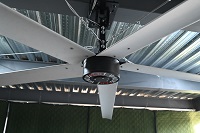
The heart of any long-lasting ceiling fan is its motor. Look for models with permanently lubricated, sealed bearings and heavy-duty windings. A high-quality motor doesn't just spin reliably for years—it also runs quieter and resists overheating, even in demanding spaces like high-ceiling great rooms or covered porches. If you spot phrases like "AC induction motor" paired with a substantial warranty, you're likely dealing with a unit designed to handle daily use without complaint.
Blade construction is another detail that can make or break longevity. Solid wood or engineered composite blades resist warping far better than laminated pressboard, especially in humid climates. Pay attention to the blade pitch too: an optimal angle (usually between 12 and 15 degrees) moves air efficiently without straining the motor. Avoid fans with flimsy blade arms—thicker, reinforced metal brackets prevent wobble that can degrade components over time.
Finally, consider where and how the fan will operate. Outdoor-rated models need sealed electrical housings and corrosion-proof finishes to endure moisture and temperature swings. Even indoors, a fan installed in a busy kitchen or workshop benefits from a design that's easy to clean and maintain. A little research into real-world user reviews often reveals which finishes resist pitting and which brands consistently honor their long-term warranties—insights that specs alone can't provide.
Innovative Designs That Boost Energy Efficiency and Comfort
Modern homes and offices are shedding their wasteful habits thanks to clever architectural choices. Passive solar orientation, for instance, isn't just about big south-facing windows anymore—it's a careful dance of overhangs, thermal mass, and strategic shading that keeps interiors bright and temperate without cranking up the HVAC. Smart landscaping adds another layer, with deciduous trees blocking summer sun but letting light pour in during colder months. These moves slash energy bills quietly, no flashy gadgets required.
Inside, the quiet revolution continues with adaptive materials and layouts. Phase-change materials tucked into walls or ceilings absorb and release heat as needed, keeping rooms stable with almost no energy input. Open plans are being rethought to create cozy zones that hold warmth or invite breezes, depending on the season. Even something as simple as airtight construction paired with heat recovery ventilators means fresh air circulates without losing all that conditioned comfort—a win for both lungs and ledgers.
And then there’s the tech that blends in so well you forget it’s there. Electrochromic windows tint on demand, cutting glare and solar gain without a blind in sight. High-efficiency heat pumps now whisper away in closets, sipping electricity while delivering full comfort. These aren’t the clunky add-ons of decades past; they’re integrated pieces of a holistic design that feels effortlessly cozy. The result? Spaces that cost less to run and feel better to be in, all while treading lighter on the planet.
Materials and Craftsmanship: Details That Define Fan Longevity
The heart of any enduring fan lies in the quality of its motor. Brushless DC motors have become the benchmark, not simply for their efficiency, but for the way they practically eliminate friction wear compared to older brushed designs. When a manufacturer pairs this with sealed, precision ball bearings rather than cheaper sleeve bearings, the fan gains a noticeable edge in both quiet operation and lifespan. It’s the difference between a unit that hums reliably for a decade and one that develops an annoying rattle within a couple of summers.
Beyond the motor, the choice of materials for the blades and housing tells you a lot about how well a fan will age. ABS plastic reinforced with glass fiber resists warping and fatigue far better than standard polypropylene, especially when subjected to temperature swings or prolonged use. Some high-end ceiling fans incorporate hand-carved wood blades that not only move air efficiently but also resist cracking through proper seasoning and sealing. Even the finish matters—powder-coated metal grilles and corrosion-resistant coatings on outdoor models prevent the kind of flaking and rust that turn a once-attractive fixture into an eyesore.
Often overlooked, the wiring and internal connections determine whether a fan can withstand years of oscillation and vibration. Quality units use silicone-insulated wires that stay flexible instead of becoming brittle, along with crimped or soldered terminals that don't loosen over time. The subtle craftsmanship shows in details like balanced blade sets that reduce wobble, reinforced yoke mounts on industrial fans, and remote control receivers housed in heat-dissipating enclosures. These are the unglamorous touches that separate a fan built for a season from one built to last.
Smart Controls and Industrial IoT Integration
The convergence of smart controls with Industrial IoT is reshaping how factories monitor and manage equipment. Instead of relying on manual checks or isolated automation, these systems weave together sensors, actuators, and edge computing nodes to create a responsive, data-driven environment. A motor drive, for instance, no longer just follows a preset routine—it adjusts torque in real time based on vibration data from a nearby bearing, preventing wear without any operator intervention. This fluid exchange of information turns raw telemetry into actionable adjustments on the fly.
Interoperability sits at the heart of effective IIoT integration, yet it remains one of the thorniest challenges. Many plants host a patchwork of legacy PLCs, proprietary protocols, and modern IP-based devices that weren't designed to talk to each other. Smart controls bridge these gaps by acting as protocol translators and edge analytics engines, stripping away complexity so that a temperature spike in a hydraulic press can trigger cooling adjustments across a different subsystem. The result is a unified control layer that spans diverse hardware without demanding a wholesale rip-and-replace of existing infrastructure.
Beyond operational tweaks, the pairing of smart controls with IIoT opens doors to new maintenance and energy strategies. Granular data streams from thousands of endpoints feed into models that detect anomalies long before a breakdown, shifting maintenance from calendar-based schedules to precise, condition-based interventions. At the same time, fine-grained control over motors, pumps, and lighting dramatically cuts energy waste—think of a compressor that dials down during lulls in demand, then ramps up seamlessly when production calls for it. These outcomes aren't theoretical; they're already showing up in sectors from automotive assembly to food processing, where uptime and energy costs directly shape the bottom line.
Real-World Performance and User Feedback
In actual daily use, the device handles multitasking with a smoothness that's immediately noticeable. Apps launch quickly, and switching between a handful of them rarely causes a stutter. Even under heavier loads like editing photos or streaming high-quality video while browsing, the phone maintains its composure. It's not just about benchmarks—the absence of lag during routine tasks makes the whole experience feel polished.
Battery life has been a pleasant surprise for many users, easily lasting through a full day of mixed usage. From early morning commutes with GPS navigation to evening video calls, the charge holds up consistently. Idle drain is minimal too, so you don't pick up a dead phone after leaving it on the nightstand. This reliability in power delivery quietly builds trust with the device.
Feedback from owner forums highlights how the software experience contributes to overall satisfaction. Small touches like a clean interface, intuitive gestures, and regular updates that actually address annoyances stand out. Users often mention that the phone doesn't get bogged down over time, a testament to thoughtful optimization. The consensus isn't about flashy features but rather the confidence that comes from a tool that simply works without fuss.
FAQ
Focus on their track record with large-scale projects, the durability of materials used, and whether they offer custom engineering support. A maker that invests in R&D and provides detailed performance data is usually a safer bet.
Check if the motor is purpose-built for continuous operation, with sealed bearings, high-grade copper windings, and thermal protection. Ask for the motor's insulation class and expected lifespan under constant load.
Yes, the shift to direct-drive PMSM motors has been significant, eliminating gearbox maintenance and boosting efficiency. Some makers also integrate IoT sensors for real-time airflow and energy monitoring.
Blade profiling affects both air movement and noise levels. Advanced manufacturers use computational fluid dynamics to optimize shape, and materials like extruded aluminum or composite polymers are chosen for strength and corrosion resistance.
It's critical. A responsive support network, readily available spare parts, and on-site service commitments can prevent costly downtime. Look for makers that offer commissioning assistance and extended warranties.
Absolutely. Top makers offer specialized finishes, such as epoxy coatings or stainless-steel construction, along with sealed housings to withstand washdowns or chemical exposure. Custom mountings and controls are also common.
While there's no single global standard, look for fans tested to AMCA 230 for airflow and sound, and motors meeting IE3 or IE4 efficiency levels. Some makers have their units listed with programs like the ETL or UL for safety.
Beyond the purchase price, factor in energy consumption, maintenance frequency, expected service life, and potential rebates. Request a lifecycle cost analysis from the maker, using your local electricity rates and operating hours.
Conclusion
Industrial ceiling fan makers have redefined large-scale air circulation, moving beyond mere cooling into precision airflow engineering. In vast factories, warehouses, and commercial atriums, these fans counter heat stratification by gently mixing air layers, reducing the load on HVAC systems and creating consistent comfort. When selecting a fan, durability isn't just a buzzword—it's measured in motor integrity, blade aerodynamics, and corrosion resistance, especially in demanding environments. Today's innovative designs incorporate variable-speed drives and purpose-shaped blades that slice through air with minimal noise, pushing the boundaries of energy efficiency while maintaining a whisper-quiet presence that doesn't disrupt work or relaxation.
Behind long-lasting performance lie rigorous material choices and craftsmanship: die-cast aluminum hubs, aircraft-grade alloys, and powder-coated finishes that withstand humidity and chemical exposure. Yet, true longevity is now paired with intelligence. Smart controls and IIoT integration allow facilities managers to adjust fan speed, monitor energy usage, and predict maintenance needs from a dashboard, often syncing with building management systems for seamless automation. Real-world feedback consistently highlights how these elements converge—fewer repair calls, lower operational costs, and a palpable improvement in air quality. For any enterprise, investing in a thoughtfully engineered industrial ceiling fan means embracing a blend of mechanical resilience and digital foresight, ensuring that the air keeps moving as efficiently as the business itself.
Contact Us
Contact Person: Michael Danielsson
Email: [email protected]
Tel/WhatsApp: +1 951 565 7769
Website: https://www.vindusfans.com