
Oil Immersed Transformer Exporter Selection Tips for Global Buyers
2026-11-24
Sourcing a reliable oil immersed transformer exporter is rarely just about price or catalog specs. For global buyers, the real challenge lies in verifying factory capability, cooling performance, and long-term service support before a shipment ever leaves the port. Whether you are comparing 33kV distribution units or custom-built substation transformers, small oversights in design or certification can turn into costly downtime. That is why this guide focuses on practical selection criteria that go beyond standard brochures. Along the way, we also look at how manufacturers like XIAOPAI approach export-level quality control, so you can evaluate suppliers with greater confidence instead of relying on guesswork.
Factory Floor Signs That Expose a Weak Exporter
Walk any factory floor and the signs tell you more than management ever will. A weak exporter often reveals itself through mismatched safety labels, faded zone markings, and handwritten corrections taped over printed instructions. These are not cosmetic details; they indicate a workplace where procedures are treated as suggestions, which eventually shows up in inconsistent product quality.
Look for signage that has not been translated for the destination market or that mixes three languages on one board without a clear hierarchy. That confusion on the wall tends to mirror confusion in the shipping documents, packaging, and compliance paperwork. When a facility cannot keep its own floor instructions coherent, it is unlikely to keep export requirements coherent either.
The most telling signs are the ones missing entirely. No batch traceability markers, no quarantine area labels, no clear walkway or forklift paths. Their absence usually matches a poor response when buyers request corrective action reports or production records. A factory that cannot label its own floor rarely labels its cartons, pallets, and invoices with the precision an exporter needs.
Paperwork Requests That Separate Agents from Real Manufacturers
A genuine manufacturer rarely treats basic documentation as a hurdle. Ask for a material data sheet, a tolerance stack-up, or a revised drawing, and the reply usually moves toward what can be produced and when. Agents tend to answer with another form: a non-disclosure agreement, a supplier questionnaire, a bank letter, a purchase-order template. The paperwork itself is not the problem; the imbalance is. When every technical question gets met with one more document request instead of a direct answer from someone who knows the tooling or the line speed, there is probably no factory sitting behind the email.
On the other side of the exchange, a real factory leaves a trail of its own documents. Inspection reports show actual cavity numbers and measured dimensions. Material certificates carry lot numbers from a specific supplier. Corrective-action records mention time-of-day production stops and rework counts. An agent can forward many of these files, but the difference appears when you push for detail. Ask which cavity ran the sample, how long the cycle was, or who did the plating, and a manufacturer tends to give an uneven, practical answer. An intermediary falls back on a tidy quote or a polished brochure PDF.
Document requests alone are not proof of anything. Some factories have formal onboarding teams, while plenty of agents have learned to speak fluent PPAP and ISO. The real test is whether the paperwork can be connected to a physical process. If you are asked to describe your requirements again and again but never receive a dated photo, a live shop-floor video, or a sample with traceable markings, treat that as a warning. Paperwork separates the two only when you notice what is missing from the file.
Voltage and Frequency Mismatches Global Buyers Miss
A surprising number of buyers assume that plugging in a machine from another region is just a matter of changing the cord. In reality, voltage and frequency differences can quietly destroy equipment or cause it to behave erratically. A motor rated for 60 Hz will run slower and hotter on a 50 Hz supply, while transformers sized for one voltage may saturate or overheat on another. What looks like a small compatibility issue on paper often turns into premature bearing wear, failed control boards, or even a fire risk after a few weeks of operation.
The problem gets worse with modern electronics. Many devices carry a label that says something like 100–240V, 50/60Hz, which leads buyers to believe everything is safe. But inside the equipment, auxiliary components such as cooling fans, relays, contactors, and sensors may still be rated for a specific local supply. A compressor that works fine in a lab in Germany might arrive in Texas and suddenly start tripping breakers because the internal contactor coil was chosen for 230V at 50Hz, not the 240V at 60Hz found on site. No single spec sheet captures all these hidden dependencies.
Experienced buyers learn to look beyond the main nameplate. They check whether the manufacturer actually certified the whole assembly for the destination grid, not just the power supply module. They ask about locked rotor current, inrush behavior, and whether the control logic relies on line frequency for timing. Small mismatches in voltage tolerance or frequency sensitivity may not show up during a quick demo, but they tend to surface after the warranty ends. Catching these details before shipment saves a lot more than just return freight.
Oil Handling Steps That Decide Transformer Lifespan
Transformer oil starts deciding the unit's fate the moment it reaches the site. New oil is rarely clean enough to use without treatment because shipping and storage introduce moisture, fibers, and abrasive particles. A better approach is to test the delivered oil first, checking moisture content, dielectric strength, and interfacial tension before any transfer. From there, purification targets should be absolute numbers rather than vague cleanup passes. Keeping moisture below 10 ppm and particle counts near ISO 16/14/11 or cleaner gives the insulation system a realistic margin against thermal and electrical stress.
Filling is where many otherwise good oil handling programs fall apart. Vacuum filling matters because it pulls trapped air and residual moisture out of the winding structure before oil enters, especially on higher voltage units. The oil should be warmer than the ambient dew point, typically between 40°C and 60°C, so moisture does not condense on the paper insulation. Flow rates also need to be restrained to avoid static charging and to keep settled particles from being stirred back into circulation. Hoses, fittings, and temporary piping should be clean and dry, since a single dirty connection can undo all the upstream purification work.
Oil handling does not stop after the first fill. Moisture and dissolved gases shift with load, temperature, and time, which makes periodic sampling more useful than relying only on online sensors. If moisture creeps upward or particle counts climb, side-stream filtration or vacuum dehydration can correct the condition before the paper insulation pays the price. Many transformers that operate reliably for thirty years or more are not remarkable by design; they simply stay in a low-moisture, low-particle, low-oxygen condition because the oil is treated as a maintenance asset rather than an afterthought.
Why Local Service Teams Beat Longer Warranty Claims
A longer warranty sounds reassuring on paper, but it rarely matters when a compressor fails on a Friday afternoon and the manufacturer's approved repair partner is three states away. Local service teams can show up, diagnose the actual fault, and often fix it the same week because they are not routing requests through a distant call center or waiting on shipped parts from a national depot. The warranty is only as useful as the logistics behind it, and that is where a nearby crew has a clear edge.
Local technicians also carry a working knowledge of the equipment, climate, and common failures in your area. Instead of working through a generic script, they see the same machines regularly and know which parts wear out first under local conditions. That familiarity leads to quicker diagnostics, fewer repeat visits, and less pressure to upsell replacements when a simple repair will do. In contrast, a longer claim window can still leave you waiting days for approval while your operation stays idle.
Perhaps the biggest difference shows up in downtime. A warranty claim may eventually cover the part or labor, but it does not recover lost production hours, missed deadlines, or the frustration of juggling backups. A local service team treats your downtime as its own problem, because its reputation depends on response time and repeat business. When the choice is between a paper promise that may drag on and a nearby crew that can act now, the practical value usually favors the local team.
Shortlisting Exporters Without Overweighting Unit Price
Unit price often becomes the loudest voice in a sourcing decision, but it is rarely the most informative one. A low quoted price can quietly shift costs into rework, missed deadlines, or compliance failures that only show up after the order has shipped. When building a shortlist, it helps to treat price as one signal among several rather than the primary filter, keeping room for suppliers whose unit cost sits slightly above the lowest bid but whose delivery history, defect rates, and responsiveness are easier to defend.
A more reliable shortlist usually comes from setting a price range first and then ranking exporters inside that band on operational evidence. Request details on packaging standards, lead-time consistency, audit results, and how they handle corrective actions when something goes wrong. Exporters that survive this kind of review tend to offer steadier total cost than those that win only on the quote sheet, and they reduce the chance of having to restart the search mid-project.
FAQ
Confirm that the exporter actually controls the production process rather than just sourcing finished units. Ask for recent factory audit reports, photos of the winding and tank welding areas, and the nameplate details of at least two units currently in production for overseas clients. A genuine manufacturer will be able to explain how core stacking, drying, and oil filling are sequenced, while a trading intermediary usually cannot answer those questions with confidence.
Look beyond the brochure numbers and request load and no-load loss test reports from a third-party laboratory or from the exporter's own routine test bay. Compare the declared losses against the values allowed in IEC 60076 or IEEE C57.12.00 for the same rating and voltage class. If the losses seem unusually low for the quoted price, ask whether the design uses higher-grade silicon steel, a larger core cross-section, or lower current density in the windings. Without a clear engineering explanation, the figures are probably optimistic.
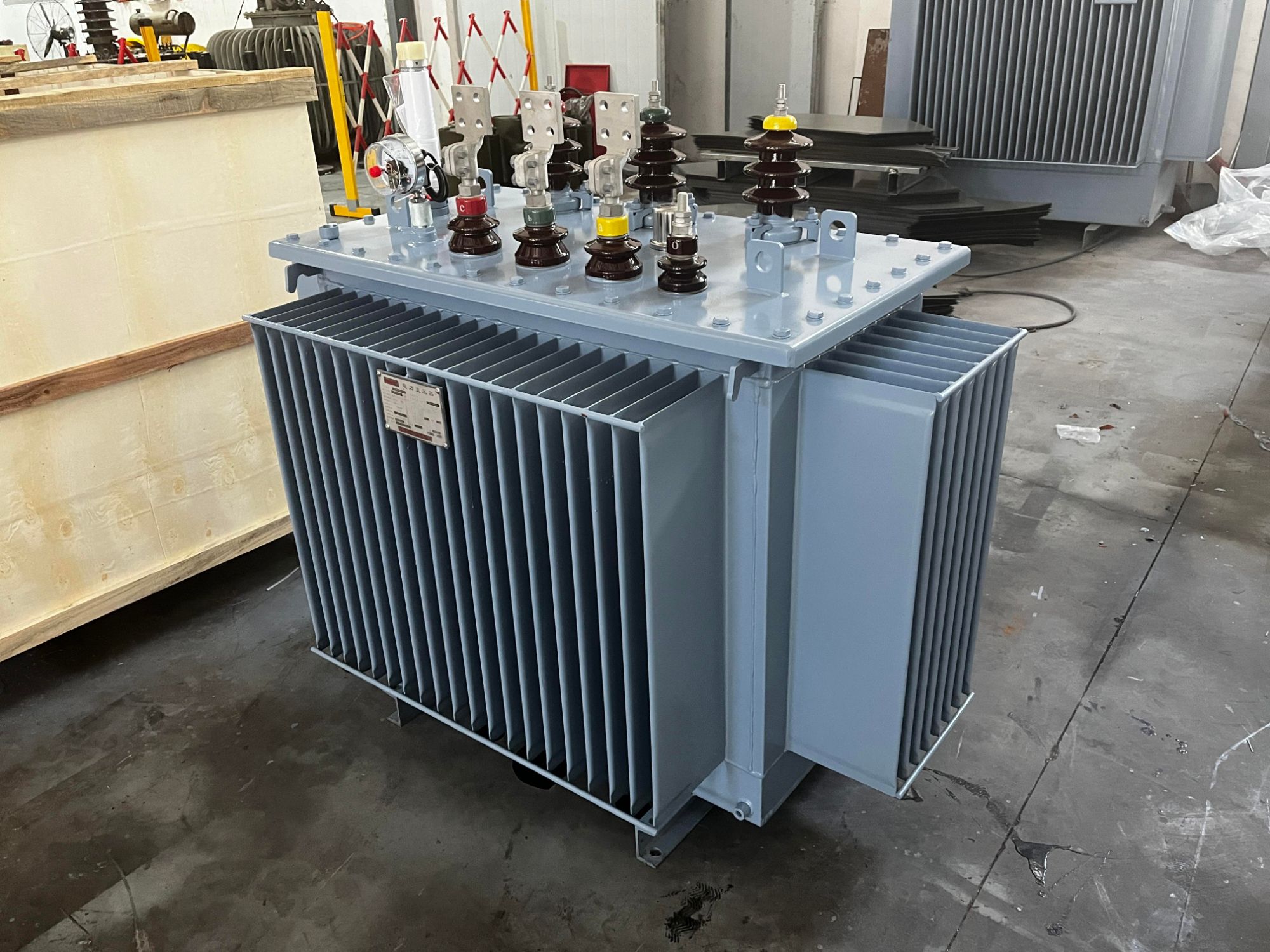
Pay attention to the type and quantity of insulating oil, the conservator design, the tap changer specification, and the accessories included as standard. Some export quotations keep the initial price low by offering mineral oil without regeneration capability, a basic off-circuit tap changer, or a minimal set of bushings and relays. Those choices can raise maintenance costs and shorten service life. A better quotation will state the oil specification, the number of tapping steps, the type of on-load tap changer if requested, and whether items like Buchholz relays, pressure relief devices, and oil level indicators are included.
Oil immersed transformers require more lifecycle care: oil sampling, drying, leak repair, gasket replacement, and eventual oil regeneration. If the exporter cannot supply commissioning supervision, spare gaskets, bushings, and technical guidance for local maintenance crews, a minor leak can become a long outage. Dry-type units are more forgiving in dusty or humid environments. For oil filled equipment, the availability of spare parts and remote support should be evaluated before the order, not after a fault.
Confirm that the transformer will be shipped with nitrogen cushioning inside the tank instead of being fully filled with oil, unless the buyer specifically requests oil-filled transport. Check that radiators, conservator, bushings, and smaller accessories are crated separately and protected against salt spray, rain, and rough handling. The exporter should provide a packing list that includes impact indicators or tilt indicators on the main tank. Also ask how the active part is braced for sea freight, because internal movement during rolling or pitching can damage windings even when the outside paint looks perfect.
At minimum, require a routine test report covering winding resistance, voltage ratio, polarity, impedance voltage, load loss, no-load loss, insulation resistance, and dielectric tests. If the unit is destined for a regulated market, ask for type test evidence from an ISO/IEC 17025 accredited laboratory, plus the relevant IEC or IEEE certificates. For markets with specific requirements, check whether the transformer meets energy efficiency regulations. A single certificate without traceable test data or serial number is not enough.
Ask for the manufacturing address and compare it with the address on the export license and quality certificates. Request a live video call from the shop floor and have the camera move from the core stacking area to the testing bay without a planned script. Genuine manufacturers can also provide the transformer serial number format used for traceability and share examples of past export documents, such as bills of lading that match the factory name. Trading companies often hesitate when asked to show the production line in real time.
The contract should clearly define incoterms, payment milestones tied to production and testing, the technical data sheet, penalties for late delivery and excessive losses, and the warranty period for both the tank and the active part. It should also specify which party pays for third-party inspection, oil testing after arrival, and spare parts. Avoid contracts that reference only "standard commercial quality" or leave the oil specification vague. A strong contract will include the exact test standards and the allowable tolerance for no-load and load losses.
Conclusion
A surprising number of sourcing decisions go wrong long before a single unit ships, and the warning signs are often visible only when you push past polished catalogues. Ask for a live walkthrough of the production floor; if the winding area is chaotic, insulation storage lacks climate control, or test bays are squeezed into a corner, the exporter is likely cutting corners that will not show up on a datasheet. Real manufacturers can show batch records, traceability sheets and internal inspection logs without hesitation, while agents tend to delay or send generic certificates. At the same time, buyers need to confirm voltage, frequency and vector group against the actual grid conditions at the destination, because a well-built transformer with the wrong taps or cooling assumptions can fail just as easily as a poorly built one. Oil handling deserves equal scrutiny: dehydration, filtration and vacuum filling should be described as a controlled process, not as an afterthought, since moisture and dissolved gas are what quietly shorten insulation life.
Service promises should be weighted by proximity rather than duration. A ten-year warranty means little if the supplier has no trained local crew, no spare parts buffer and no diagnostic equipment in the buyer's region; a shorter but locally supported arrangement usually restores uptime faster. When comparing exporters, avoid letting unit price dominate the shortlist. Instead, build a like-for-like comparison around tested losses, oil quality guarantees, reference projects in similar climates, and the cost of routine maintenance over the first decade. Buyers who treat the transformer as a long-term operating asset rather than a one-off purchase tend to end up with an exporter that understands thermal performance, logistics and after-sales reality, not just the lowest quoted number.
Contact Us
Contact Person: Kellen Chen
Email: [email protected]
Tel/WhatsApp: 8613806536768
Website: https://www.cnxiaopai.com