

Professional Medical Disposable Manifolds What Every Healthcare Provider Should Know
2026-09-02
When a manifold fails, it rarely announces itself. A subtle leak, a slight pressure drift, or a connection that loosens under routine handling can compromise an entire infusion setup. Yet these disposable components often get less attention than the pumps and monitors they connect. This post cuts through the noise and focuses on what healthcare providers actually need to evaluate—from dead space and flow dynamics to chemical resistance and secure luer fittings. It also explains why INT has become a go-to choice for teams that refuse to leave fluid delivery to chance.
Why Disposable Manifolds Belong in Every Infection Control Protocol
In busy clinical environments, reusable manifolds quietly accumulate biofilm in the crevices that brushes and enzymatic soaks never fully reach. Even with meticulous reprocessing, the risk of residual contamination lingers between patients. A disposable manifold removes that variable entirely—each patient starts with a clean, dedicated pathway for fluids or pressure monitoring, so there is no shared surface left to harbor pathogens from a previous case.
The cost argument often favors reusables until you factor in the labor, water, chemical disinfectants, and the inevitable re-cleaning when a spot check fails. Disposable manifolds collapse that workflow into a predictable single-use step. Nurses and perfusionists can open a sterile package, connect, and move on without second-guessing whether an internal lumen was properly flushed.
Infection control protocols are only as strong as their weakest reusable component. By making the manifold a disposable item, you eliminate a hidden reservoir and give staff one less item to track, label, and reprocess under time pressure. That simplicity alone makes it a practical addition to any protocol aiming for consistent, auditable patient safety.
Dead Space, Thrombosis, and the Design Flaws Hiding in Plain Sight
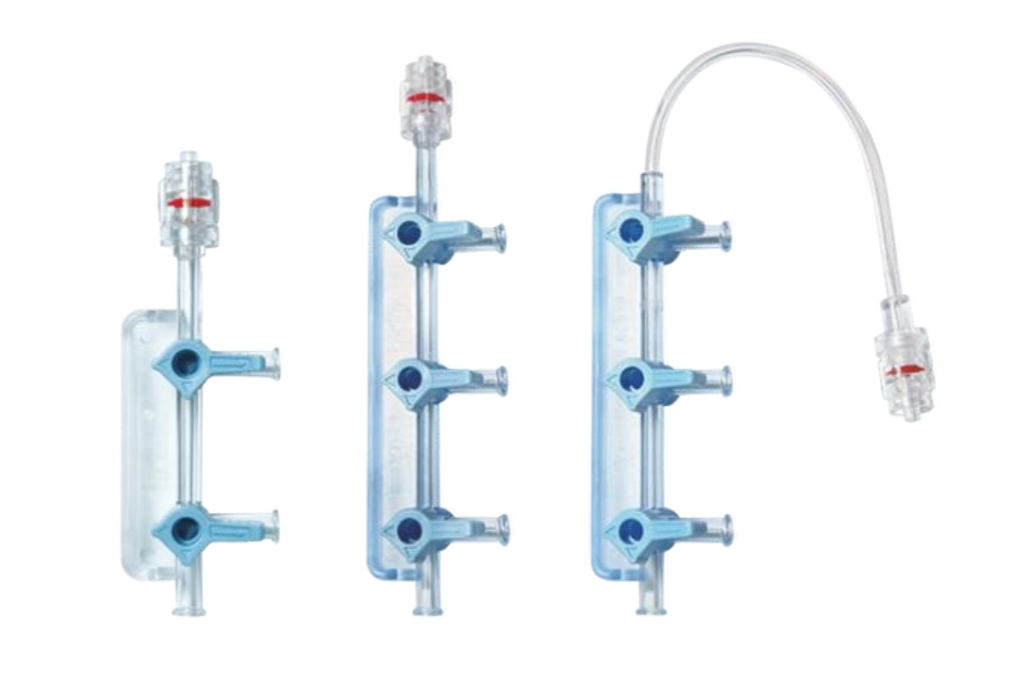
A catheter hub that doesn't fully flush leaves a stagnant pocket where blood can sit for hours. That pocket is dead space, and it's one of the most overlooked triggers for catheter-related thrombosis. Even with a flawless insertion technique, the geometry of the device itself can create low-flow zones that let platelets aggregate and fibrin form.
The flaws aren't exotic. A side port that's slightly off-axis, a clamp that closes just shy of the tubing wall, a luer connection with a recessed shoulder—each one creates a micro-eddy where blood lingers. Manufacturers often test for leaks and pressure ratings, but not for what happens to a drop of blood in that tiny void during the pause between flushes.
Redesigning these components means rethinking what "secure" and "leak-free" actually require. Smooth internal tapers, minimal dead-end branches, and flush pathways that sweep the entire lumen can cut thrombus formation without adding cost. The problem isn't a mystery material or an untested drug—it's a set of design habits that haven't caught up with clinical reality.
Polycarbonate vs. Polyethylene: Material Choices That Affect Drug Delivery
Polycarbonate and polyethylene serve very different roles in drug delivery, and the choice often comes down to what the device demands from its housing or fluid path. Polycarbonate's high clarity and stiffness make it a natural fit for components where a clinician needs to visually confirm dose accuracy or check for particulate matter before injection. But that rigidity comes with a trade-off: polycarbonate can be more vulnerable to stress cracking when exposed to certain solvents or lipid-based formulations, which sometimes limits its use in long-term implantable systems. Polyethylene, by contrast, is remarkably forgiving. Its flexibility and low moisture uptake allow it to handle repeated flexing in tubing or squeeze bottles without fatigue, and it tends to hold up well against aggressive pH ranges that would degrade other plastics.
The more subtle differences show up at the molecular interface. Polycarbonate has a history of raising concern over residual bisphenol A and other additives that can migrate into drug solutions under heat or alkaline conditions, especially during autoclaving or gamma sterilization. Polyethylene, particularly the high-density grade, generally presents a cleaner extractables profile, but it isn't passive either: lipophilic drugs can partition into the polymer matrix over time, effectively reducing the delivered dose. That's why formulation scientists often run sorption studies early. A protein-based drug sitting in a polyethylene IV bag for 24 hours might lose a measurable fraction to the plastic, whereas a small-molecule suspension in a polycarbonate syringe might show pH drift from leached monomers. Neither material is universally safer; it's about matching the specific drug chemistry and delivery window to the polymer's weaknesses.
In practice, many combination products mix both materials strategically. A pre-filled syringe might use a polycarbonate barrel for its transparency and dimensional precision, then switch to a polyethylene plunger stopper coated with a fluoropolymer to reduce friction and sorption. An auto-injector could rely on polyethylene for the inner drug reservoir and polycarbonate for the outer shell that must survive a drop onto concrete. These aren't arbitrary choices—they're driven by stability data, extraction testing, and real-world handling conditions. When a drug delivery system fails, it's rarely because the polymer was inherently unsuitable but because the material's property profile didn't align with the specific stress it encountered. That alignment is what separates a reliable device from one that causes dosing errors.
Single-Use vs. Reprocessed Manifolds: The True Cost of Reuse
When hospitals weigh single-use manifolds against reprocessed ones, the sticker price rarely tells the whole story. A fresh, sterile manifold costs a few dollars per unit and gets tossed after one procedure—no cleaning, no testing, no liability worries. Reprocessed manifolds, on the other hand, might cut per-use expenses by 40% or more, but those savings come wrapped in hidden line items: collection fees, decontamination labor, validation runs, and the occasional device that fails inspection and must be replaced. Over a year, a busy cath lab can save thousands, yet only if the reprocessing partner maintains consistent quality and the hospital keeps strict tracking protocols.
The math shifts again when you factor in downtime and risk. A single-use manifold opens in seconds and is always ready. A reprocessed one depends on turnaround time—if the vendor runs late or the hospital’s reusable inventory runs low, cases get delayed or clinicians scramble for substitutes. Then there's the clinical question: while reprocessed manifolds cleared by regulators show no higher infection rates in most studies, a single device failure or contamination scare can erase years of cost savings through extended patient stays, litigation, or reputational damage. For many facilities, the true cost isn't just dollars per use but the price of certainty.
That doesn't mean reprocessing is always the wrong call. High-volume centers with dedicated reprocessing staff and reliable vendors often come out ahead, while smaller clinics may find the administrative burden eats the margin. Some hospitals hedge by using single-use manifolds for complex or immunocompromised patients and reprocessed units for routine cases. The decision ultimately hinges on local logistics, case mix, and how much weight leadership assigns to predictable expenses versus long-tail risks.
Matching Manifold Ports to Real ICU and OR Workflows
In a busy ICU, the manifold isn't just a plastic block with ports—it's the silent switchboard of the patient's vascular access. Each port gets assigned a role based on the unit's actual routines: the central lumen for continuous sedation, a side port for intermittent antibiotics, and one kept strictly for blood draws. Nurses don't want to think twice about which line goes where; the manifold layout has to mirror the sequence of care they already perform a dozen times per shift.
Operating rooms take that logic a step further. Anesthesia providers need ports arranged so that vasopressors and maintenance fluids don't cross paths unexpectedly, and a dedicated port for rapid transfusion sits close to the surgical field. When a manifold isn't matched to these workflows, people start improvising with stopcocks and extension tubing—and that's when dead space, contamination risks, and dosing errors creep in. The best designs come from watching real cases unfold, not from generic diagrams.
Matching ports to real workflows also means accepting that no two units are identical. A cardiac ICU might want a high-flow port near the transducer, while a neuro ICU prioritizes a low-volume line for precise drug titration. The goal is to make the manifold feel almost invisible—so intuitive that a new nurse or a traveling anesthetist can glance at it and immediately understand what connects where, without a handoff note.
Pressure Tolerance and Flow Rate Checks Every Provider Should Perform
Many clinics skip the simplest checks, assuming that if a device turns on, it's working fine. Pressure tolerance isn't just about avoiding leaks—it's about matching the patient's anatomical limits so therapy actually reaches the target area. Start with a baseline tolerance test using a manometer or inline sensor while the patient is at rest, then repeat it during a mild activity like walking or flexing. A difference of more than 10% usually signals a fitting issue or a kink that won't show up on a static exam.
Flow rate checks are often treated as an afterthought, but they reveal how well the entire delivery path holds up under real conditions. Connect a calibrated flow meter at the distal end and run the system for at least five minutes, not the usual ten-second spot check. Watch for gradual drops that indicate micro-clogs or tubing compression. If the flow falls below the manufacturer's minimum for that device size, don't just crank up the pressure—trace the line from the reservoir to the connector and feel for soft spots or stiffness changes.
One overlooked step is repeating both checks after any adjustment, no matter how minor. A new cushion, a longer tube, or even a different strap placement can shift both pressure tolerance and flow by surprising amounts. Build a quick checklist that pairs these two measurements together, and record the numbers in the patient's chart with the date and position tested. Over time, you'll spot trends—like a slow decline in flow that predicts an occlusion before it causes a clinical problem. That kind of proactive habit sets a provider apart far more than any brochure claim.
FAQ
A disposable manifold is a single-use, multi-port device that consolidates pressure monitoring, blood sampling, and medication delivery into one closed system. You'll typically see three to five stopcocks mounted on a rigid or semi-rigid base, with one transducer connection and a continuous flush line. It replaces hand-assembled stopcock stacks, so the number of connection points drops sharply, which matters in critical care and anesthesia.
Reusable manifolds demand cleaning, sterilization, and tracking between patients, which creates gaps where biofilms and cross-contamination can survive. Disposable versions remove that entire chain. They're cheaper on a per-case basis when you factor in labor and sterilization validation, and they arrive sterile, primed, and ready to connect, which shortens setup time during line placement.
Check the transducer dome is seated and the flush solution bag is pressurized to 300 mmHg with a flow rate around 3 mL/hour. Confirm all stopcock handles move freely and point toward the correct ports before you connect the patient line. Also prime the entire manifold, tapping the dome and stopcocks to dislodge air bubbles, because even a small bubble will dampen the arterial waveform and give you false readings.
Stopcock orientation determines which ports are open or closed to the patient and the flush system. A common error is turning the wrong handle during a zeroing procedure, which can accidentally bolus medication or let blood back up the line. Before each manipulation, trace the flow path out loud or with your finger, and return all handles to the monitoring position afterward, especially during handoffs.
Manifolds reduce the number of luer connections and entry points compared to traditional stopcock towers. Fewer connections mean fewer opportunities for contamination during blood draws or medication administration. The closed, continuous flush system also minimizes stagnant blood in the line, which lowers the chance of bacterial growth. But the manifold only works as an infection control tool if you scrub the hub for 15 seconds with an appropriate antiseptic and let it dry before every access.
Not always. Most manifolds use standard luer fittings, so physical compatibility is usually fine, but the transducer connection can vary slightly between manufacturers. Some cables and domes are proprietary or have different electrical connectors. You need to match the manifold to the transducer and cable system already in use. It's not just a plug-and-play decision, even though the clinical function looks the same.
Watch for a falsely dampened waveform, difficulty aspirating blood, or a rising pressure in the flush bag without a corresponding drip in the flush chamber. If the waveform suddenly goes flat during a fast flush and doesn't return to baseline promptly, suspect a kinked or clotted line, a closed stopcock, or an air bubble trapped in the dome. Any persistent discrepancy between the arterial line reading and a non-invasive blood pressure check should trigger a full manifold inspection.
Dispose of the entire manifold, tubing, and transducer as a single unit in an approved biohazard sharps or medical waste container according to facility policy. Do not recap needles if any are attached, and avoid detaching components because that creates a splash or contamination risk. Always double-check that all patient connections are removed before discarding, and document removal in the patient record if your unit's protocol requires it.
Conclusion
Disposable manifolds are not just another supply item—they are a frontline defense against cross-contamination in high-stakes environments like the ICU and operating room. Infection control protocols that still tolerate reusable or improvised manifold setups are ignoring a simple truth: every connection point is a potential entry for pathogens. Single-use manifolds eliminate the reprocessing variability that plagues even the most diligent central sterile departments. Beyond sterility, their clinical performance hinges on details many providers overlook. Dead space in poorly designed manifolds can trap blood or medication, creating a nidus for thrombosis or delayed drug delivery. The material matters too: polycarbonate offers clarity and rigidity for precise visualization, while polyethylene provides flexibility and lower binding for certain infusates—choosing wrong can alter hemodynamic readings or reduce drug bioavailability. And while the upfront cost of disposable manifolds may seem higher than reprocessing, the true expense of reuse includes labor, validation, and the catastrophic cost of a single hospital-acquired infection.
Practical workflow integration demands more than a generic multi-port hub. Real ICU and OR settings require manifold port configurations that match actual line needs—arterial monitoring, central venous pressure, multiple vasopressor infusions—without forcing clinicians to daisy-chain adapters that increase failure points. Providers should routinely perform simple pre-use checks: verify pressure tolerance against the pump settings, ensure flow rates at each port meet clinical demands, and confirm that dead space volume is minimal. A manifold that passes a visual inspection but fails a pressure test is a liability. The best disposable manifolds are engineered with low-resistance stopcocks, clear labeling, and smooth rotating handles that prevent accidental line occlusion. By pairing rigorous device evaluation with a firm commitment to single-use policy, healthcare teams can reduce both thrombotic complications and infection rates—turning a seemingly mundane component into a measurable safety advantage.
Contact Us
Contact Person: Jeffrey
Email: [email protected]
Tel/WhatsApp: 86-0633-2230056
Website: https://www.sd-intmedical.com