

Top Drill Rod Factory: What Makes a Manufacturer Stand Out
2026-08-14
When it comes to sourcing drill rods, the difference between a supplier and a true manufacturing partner often boils down to a few critical details. But what exactly separates the best from the rest? From raw material integrity to heat treatment precision and real-world performance under extreme conditions, the answer isn’t always obvious. In this blog, we peel back the layers of what makes a drill rod factory genuinely stand out—with insights drawn from PULANKA, a name that has quietly set new benchmarks in the industry.
The Metallurgy Behind a Drill Rod That Won’t Quit
A drill rod that shrugs off punishing torque and abrasive rock isn't a fluke of chance—it's a deliberate metallurgical balancing act. The base steel is typically a high-carbon alloy, often in the S2 or 4340 family, where carbon pushes hardenability while chromium, molybdenum, and vanadium build a fine-grained, wear-resistant matrix. Vanadium deserves special mention: it forms microscopic carbides that act like speed bumps against crack propagation. Too much carbon, though, and the steel turns brittle; too little, and the cutting edge rolls over after a dozen holes. The best rods land in a narrow window—usually 0.40–0.55% carbon—where strength and ductility coexist.
The real magic happens in the heat-treat cycle. After forging and rough machining, the rod is austenitized at a precise temperature (often 850–900°C for S2), quenched in oil or salt to lock in a martensitic structure, then double-tempered around 200–400°C. This isn't a one-size-fits-all recipe; the exact tempering temperature shifts depending on whether the rod will see impact or sustained torsion. A rod tempered too low shatters like glass; one tempered too high loses its edge and bends. Good shops test every batch with a Rockwell hardness target—typically 54–58 HRC—but they also run Charpy impact tests, because a hard rod that snaps on the third hole is worse than a softer one that slowly dulls.
What separates a rod that "won't quit" from one that fails early is often hidden in the microstructure. A uniform distribution of tempered martensite with fine, spherical carbides resists both fatigue and abrasive wear. Poor quenching leaves soft spots or retained austenite, which later transforms under stress and causes dimensional drift. Some premium rods also get a surface treatment—shot peening to induce compressive stress, or a thin nitride layer for extra hardness—but these are secondary to the core metallurgy. The end result is a tool that bends slightly under overload instead of snapping, wears gradually instead of chipping, and keeps its straightness after hundreds of meters of brutal rock contact.
Precision Machining Where a Few Microns Decide the Job
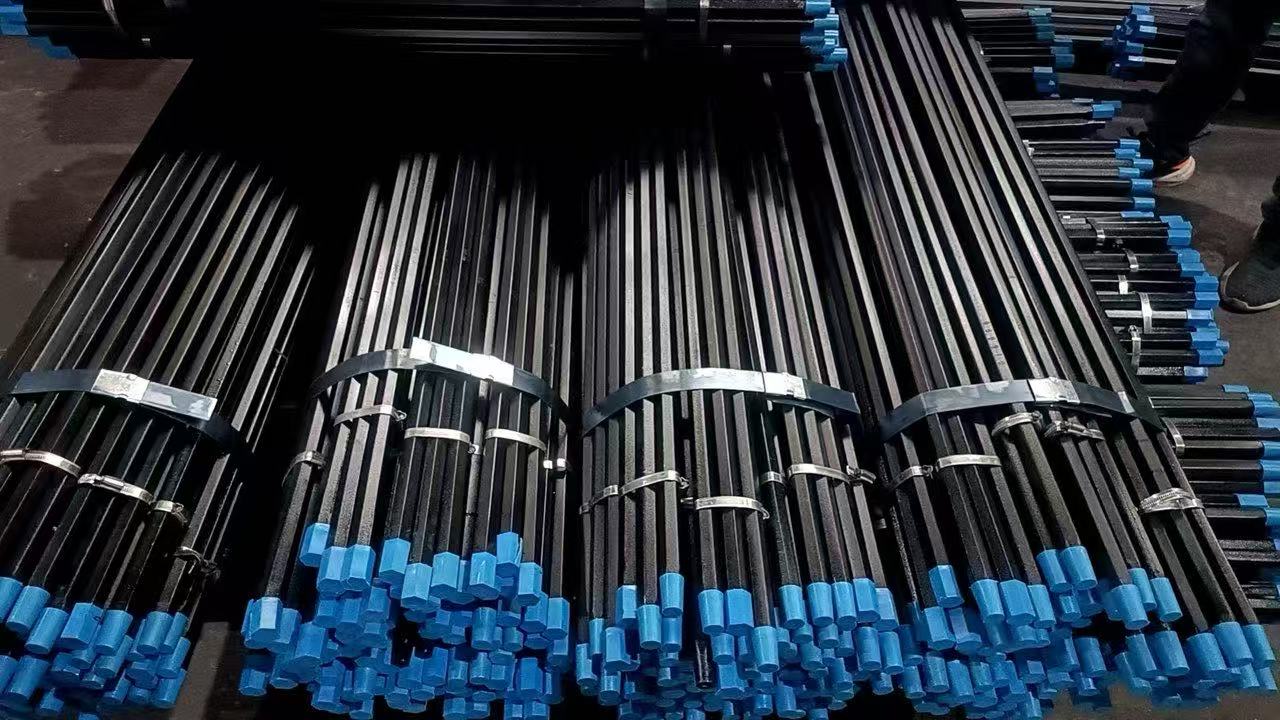
A micron is roughly a quarter of the diameter of a human hair, yet on a CNC lathe or jig grinder it can separate a perfect drop-in replacement from a part that gets sent straight to the scrap bin. Shops working at this level don't rely on post-process inspection alone. They control thermal drift during long unattended runs, compensate for tool wear every few cycles, and keep coolant temperature stable enough that a 0.004 mm shift never sneaks into a bore or a bearing seat.
The real difference shows up in how problems are chased. When a feature drifts two microns out of spec, it is rarely the machine's fault. It is more often a fixture clamping the part slightly differently, a batch of bar stock with different residual stress, or an operator touching a part with bare hands for thirty seconds. The best shops treat those microns as clues. They measure more, adjust sooner, and document everything so the next run doesn't inherit the same quiet failure.
Thread Profiles Shaped by Field Failures, Not Guesswork
When a threaded connection fails in the field, the fracture surface and worn flanks tell a story that no CAD model can predict. Engineers who spend time examining stripped threads, fatigue cracks at the root radius, or galling damage on stainless steel fasteners quickly learn that the as-designed profile rarely matches the as-endured reality. The gaps between theoretical load distribution and actual contact patterns are where failures hide.
Instead of tweaking thread geometry based on intuition or generic standards, field failure analysis forces the profile to adapt to observed damage. For example, repeated fatigue cracks initiating at the first engaged thread often point to uneven load sharing—something that a uniform pitch calculation might miss. By measuring deformed roots, mapping wear bands, and sectioning failed bolts, designers can shift material to where it actually carries load, or adjust flank angles to reduce stress concentration. These changes are not speculative; they are reverse-engineered from broken parts.
The result is a thread profile that has been pressure-tested by reality rather than just simulated. It may deviate from textbook geometry—a slightly larger root radius, a modified crest truncation, or an asymmetrical flank—but each deviation corresponds to a documented failure mode that was resolved. Over time, this feedback loop builds a library of profiles tied to specific application environments: vibration, thermal cycling, corrosion, or overload. Designers can then select a shape that has already proven itself where it matters most.
Testing That Throws Your Worst Rock Formations at the Rod
The test rig isn't a polished lab bench. We drag each rod across jagged basalt edges, grind the blank against limestone shelves, and jam the tip into crevices filled with coarse grit. These are the same nasty surprises you find when a big fish dives for cover—only here the rod has nowhere to hide.
Guides get hammered by sharp stone corners, and the reel seat is twisted while the blank is pinned under pressure. We don't wait for a clean failure; we look for micro fractures, loosened inserts, or any sign that the carbon layers are delaminating after repeated rock contact. If a rod survives this without losing sensitivity or structural integrity, it earns a spot in the lineup.
Traceability That Follows Every Rod From Billet to Borehole
The rod’s stamped pin code isn’t just a serial number—it ties back to a specific heat of steel poured at the mill. That heat number carries the ladle chemistry, billet bloom position, and rolling sequence, so the exact origin of every bar is known before it ever reaches the sucker rod shop.
Once the billet enters production, the identifier follows through induction heating, upset forging, heat treatment, and final machining. Each step logs its parameters—quench temperature, tempering time, thread lead, and coating cure—against that same code. The result is a complete, unbroken record that can be recalled with a simple scan at the borehole.
For operators, that means no more wondering whether a mixed batch of rods ended up on a well. If a material issue surfaces, you can trace every affected rod from the foundry to the wellhead and pull only the suspect pieces. It shortens downtime and ends the practice of replacing entire strings out of caution.
An Engineering Desk That Answers Before the Sales Pitch
Most sales calls start with a pitch. Ours start with a tolerance stack-up, a material spec, and a real answer about whether your part can be made the way you drew it. When you reach our engineering desk, you're not routed through a script; you're talking to the same people who will later sign off on the tooling or the machining plan. That means the conversation often skips the usual back-and-forth and goes straight to the geometry that matters.
It changes the rhythm of a project. Instead of waiting for a quote to reveal that a wall thickness is too thin or a surface finish is unrealistic, you find out while the idea is still warm. The desk keeps a running log of past challenges—similar alloys, similar draft angles, similar failure points—so the person answering already has context before you finish describing the problem. For teams tired of hearing 'let me check and get back to you,' it's a quiet but obvious difference.
FAQ
The best factories can trace every heat number back to the mill and confirm the exact grade, not just a generic 4140 designation but the acceptable ranges for sulfur, phosphorus, and residual elements. They also reject material that doesn't meet their own incoming hardness or ultrasonic testing, even if the mill cert says it passed. That extra inbound check catches problems before machining starts.
Instead of running large batches through a generic furnace cycle, top plants tune soak times and quenching based on the actual diameter and wall thickness of each rod. They also verify case depth or through-hardening on cut samples from the same lot, not just on test coupons. The result is a rod that stays straight and resists thread deformation under repeated make-and-break cycles.
Threads are where fatigue cracks usually start. A standout factory controls thread root radius, surface finish, and lead error tightly, and uses dedicated thread grinders or high-end CNC lathes rather than worn-out manual equipment. They also inspect thread form with optical comparators or CMMs, not just a ring gauge, because a thread that gauges 'go' can still have stress risers from chatter or improper relief.
A real partner can adjust upset length, wall thickness, thread profile, and even alloy chemistry for your specific ground conditions. They don't just re-label a stock bar. They ask about your rig type, depth, rock formation, and failure history, then propose changes like a longer heat-treated zone or a different shoulder design. That back-and-forth is a good sign.
Ask for batch-to-batch data on straightness, hardness, and thread dimensional reports over the last six months, not just a single golden sample. If they hesitate or give you only a certificate of conformance without actual measured values, that's a red flag. Consistent factories keep run charts and can show the spread, not just the average.
The best manufacturers don't wait for a purchase order to start raw material planning. They forecast demand by diameter and grade, keep safety stock of common sizes, and have backup suppliers for alloy steel. They also stage partial shipments when a heat-treatment furnace goes down, and their packaging prevents thread damage during ocean freight, so the rods arrive ready to run, not needing rework.
The purchase price looks attractive until you count premature thread failures, hole deviations from poor straightness, and downtime while waiting for replacements. Low-cost rods often skimp on final straightening, stress relief, or thread protection, which shows up as higher cost per meter drilled. Factor in lost drilling time and the math flips quickly.
Conclusion
The best drill rod factories earn their reputation in the gap between a spec sheet and a brutal borehole. It starts with steel that is blended and heat-treated to resist fatigue, not just to hit a hardness number. A top shop pairs that with machining tolerances measured in microns, because a slight runout at the collar becomes a snapped string downhole. Thread profiles are not copied from catalogs; they are revised after field failures, with root radii and flank angles tweaked so connections stay tight under percussive shock. This kind of iterative refinement separates manufacturers who sell rods from those who solve drilling problems.
What really sets a standout factory apart is how it validates its work. It tests prototypes against simulated rock formations that mirror the customer's worst ground—abrasive granite, fractured shale, hard boulders—rather than relying on generic lab loads. Every rod also carries full traceability from billet heat number to final inspection, so if one fails, the root cause is known within hours, not weeks. And the engineering desk answers before the sales pitch, meaning a customer gets honest guidance on torque limits, drilling parameters, and failure analysis instead of a brochure. Those quiet, unglamorous habits are what keep a drill string turning long after cheaper rods have been pulled.
Contact Us
Contact Person: Elma
Email: [email protected]
Tel/WhatsApp: +86 13738628777
Website: https://www.pulankagroup.com/