

Top Medium Voltage Switchgear Factory Delivering Reliable Power Distribution Solutions
2026-09-28
Power distribution rarely makes headlines until something goes wrong. For facility managers and electrical engineers, the medium voltage switchgear you install today determines how quietly tomorrow runs. CNKEEYA has built its factory around that principle—turning reliability into a measurable spec rather than a marketing promise. Here is what makes their approach different from the usual catalog of options.
How We Engineer Consistency Into Every Medium Voltage Panel
Consistency starts long before assembly. We don't rely on a single supplier or batch of parts; every breaker, bus bar, and insulator comes from locked specifications and gets measured against the same dimensional and electrical baselines week after week. The goal isn't just a panel that passes inspection—it's a panel that behaves the same as the last one when it's installed next to it.
On the floor, each panel moves through the same torque sequence, the same crimp tools, and the same test points. Operators follow build books with photographs from approved reference units, not just text. If a step varies by more than a fraction of a millimeter or a milliohm, the line stops until it's corrected. That discipline removes the 'good enough' variability that shows up later as hot spots or nuisance trips.
Before shipment, we run every panel through the same thermal scan at rated load, the same dielectric test, and the same mechanical interlock cycle count. The results are logged against the serial number, not averaged across a batch. If a panel's readings drift outside the narrow band we've set, it's rebuilt or scrapped—no variance leaves the floor.
Built for the Grids That Can't Afford to Stop
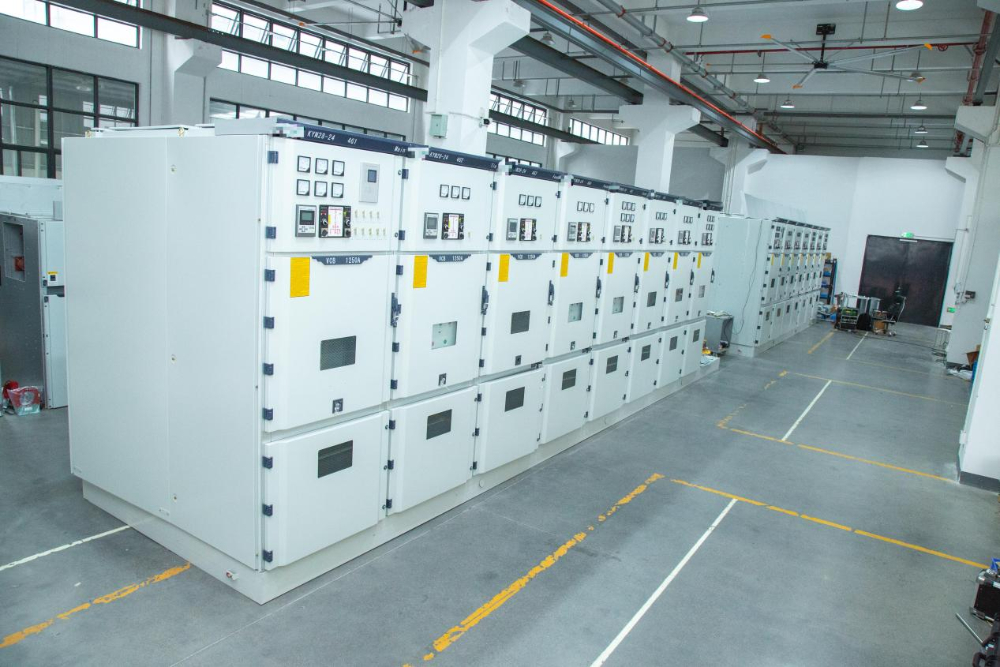
In the world of power delivery, there is no room for pause. Substations, transmission corridors, and distribution nodes operate under relentless demand, where even a fraction of a second of downtime can ripple into widespread outages, safety risks, and financial loss. This reality demands infrastructure that treats continuous operation not as a goal, but as a baseline assumption. The systems we deploy are engineered around that premise, from the first bolt to the final software check.
What sets truly dependable grid hardware apart is how it behaves when conditions turn hostile. Extreme temperatures, salt-laden coastal air, seismic stress, or sudden load spikes—these are not edge cases for critical networks. Our components are built with redundant pathways and self-diagnostic routines that catch degradation before it becomes failure. Maintenance windows shrink because the equipment communicates its own health, allowing crews to replace parts proactively instead of racing to restore service after an outage.
The result is a grid that earns the trust of the communities and industries relying on it. Hospitals keep their backup systems dormant, factories run full shifts without voltage sag, and control rooms see fewer alarms. That quiet confidence doesn't come from marketing claims or generic reliability percentages. It comes from design choices that favor proven mechanical integrity, conservative thermal margins, and field-upgradeable modules over fragile cutting-edge shortcuts. When the grid cannot afford to stop, every component must carry that weight without complaint.
Inside the Factory Floor Where Precision Meets Power
The hum of servo motors is the first thing you notice here, not because it's loud, but because it's constant—a low, deliberate thrum that tells you every axis is under control. The factory floor stretches under banks of LED lights, their cool glow spilling across polished concrete and the matte black frames of CNC machines. There's no clutter, no idle chatter. Just rows of equipment waiting for the next cycle, their operators moving with the kind of economy that comes from knowing exactly where every tool belongs.
Precision here isn't a slogan; it's a tolerance measured in microns. A technician leans into an optical comparator, checking a part that will eventually sit inside a hydraulic manifold. Behind her, a robotic arm places a forged blank into a five-axis mill, and the spindle spins up with a smoothness that makes the air itself feel tighter. Each pass of the cutter removes material so finely that the difference between acceptable and scrap is thinner than a human hair. That's where the power comes in—not brute force, but controlled force, harnessed so tightly it can carve a pocket for an O-ring seal without leaving a single burr.
Walk farther down the line and you'll see the marriage of the two: a torque wrench whose digital display reads to the second decimal, a laser alignment system that corrects for thermal drift in real time, a press that applies 40,000 pounds of force yet stops within 0.01 millimeter of its target. The people who run this floor don't rush. They verify, adjust, and verify again. Because when precision and power meet, the result isn't just a finished component—it's the quiet confidence that the machine it goes into will hold up under load, cycle after cycle, without anyone ever wondering whether the factory did its job.
From Raw Copper to Reliable Switchgear: A Closer Look
The journey begins with electrolytic tough pitch copper, chosen for its conductivity above 100% IACS and predictable work-hardening behavior. Billets are preheated to a narrow temperature band before extrusion, which keeps grain growth uniform and avoids the surface tearing that plagues rushed batches.
Busbar profiles are drawn through precision dies, then aged under controlled tension to lock in dimensional stability. This matters because switchgear contacts rely on flatness tolerances measured in microns—any residual stress turns into hot spots once current flows. The copper is then selectively plated with silver at contact pads, using a pulse-reversal technique that deposits a denser layer than conventional DC plating.
Finally, each conductor assembly undergoes thermal cycling from -40°C to 130°C while resistance is monitored in real time. Joints that drift beyond 5 micro-ohms are rejected, not reworked. The result is a current path that stays mechanically quiet and electrically consistent for decades, even under repeated short-circuit events.
What Sets Our Medium Voltage Solutions Apart in the Field
When you're standing next to a switchgear lineup that's been running for a decade without a single unplanned outage, the difference isn't marketing language. It's the way our medium voltage breakers are built: solid copper bus connections torqued to spec, vacuum interrupters rated for over 30,000 operations, and protective relays that don't need a manual to interpret. Field technicians tell us they can trace a fault in minutes, not hours, because every terminal block is clearly labeled and the control wiring follows a logical, color-coded scheme that matches the drawings exactly.
What really separates our solution is the ability to withstand the abuse of real-world installations. We've seen competitors' equipment fail because a cable lug wasn't quite tight or a rodent found its way into a bus compartment. Our designs include fully insulated busbar systems, arc-resistant enclosures tested to actual IEC standards, and front-accessible CT compartments that allow routine inspection without a shutdown. This isn't just about passing a type test; it's about surviving the vibration of a rock crusher, the salt air of a coastal substation, and the dust of a cement plant.
And then there's the support side. When a contractor calls at 3 a.m. with a sync check alarm, they get a engineer who can walk them through the relay logic, not a call center script. Our medium voltage packages ship with pre-commissioning checklists, custom logic templates for common industrial loads, and a direct line to the engineering team that actually designed the panel. That's why repeat customers say they specify our gear not because it's cheaper, but because they know it will start up on the first attempt and keep running until the next scheduled outage.
Meeting the Demands of Modern Power Distribution Without Compromise
Grid operators today face a reality where legacy infrastructure no longer matches the pace of load growth, renewable integration, and the need for unbroken uptime. Rather than patching aging switchgear or accepting voltage sag as inevitable, forward-thinking utilities are rethinking distribution from the ground up—prioritizing modular designs, intelligent monitoring, and protection schemes that adapt in real time. The goal isn't just to keep the lights on, but to deliver power quality that sensitive industries and data centers can actually rely on.
This shift demands equipment that performs under pressure without adding complexity. Compact gas-insulated switchgear, solid-state fault current limiters, and self-healing feeder automation are moving from pilot projects to standard practice. By embedding sensors at every critical node, operators gain visibility into thermal stress, partial discharge, and load imbalance long before a failure occurs. The result is a distribution network that doesn't trade safety for capacity—or reliability for cost.
At the core of this evolution is a simple principle: uncompromising performance means designing for the worst day, not the average one. Whether it's a coastal substation facing salt-laden winds or an urban vault with tight space constraints, modern power distribution must hold its own. By combining rugged engineering with adaptive control, utilities can meet rising demand while maintaining the margins that keep communities safe and operations running smoothly.
FAQ
We produce air-insulated, gas-insulated, and solid-insulated switchgear panels covering 3.3kV to 40.5kV. Our range includes both withdrawable and fixed configurations, along with specialized designs for compact substations and harsh environments.
Every unit undergoes routine tests like dielectric, temperature rise, and short-circuit withstand checks before leaving the factory. We also run type tests on prototype assemblies and use only certified components from long-term suppliers, which keeps field failure rates extremely low.
Yes, we regularly adapt busbar ratings, protection schemes, enclosure ingress protection, and internal arc classifications to match project needs. Recent examples include seismic-rated frames, anti-corrosion coatings for coastal installations, and custom mimic panels for local operator preferences.
Our equipment is found in utility substations, data centers, mining operations, oil and gas facilities, hospitals, and large commercial buildings. We also supply specialized versions for solar farms and wind power collection systems where frequent switching and harsh weather demand extra robustness.
We maintain ISO 9001, ISO 14001, and ISO 45001 certifications. Our switchgear also carries type test reports from independent labs such as KEMA and CESI, covering internal arc, short-circuit, and temperature rise performance according to IEC 62271 standards.
For standard configurations without unusual accessories, we usually ship within 8 to 12 weeks after drawing approval. Projects requiring full type-tested assemblies or special protection relays may extend to 16 weeks, but we keep buffer stock of common breakers and panels to shorten urgent orders.
We offer commissioning supervision, on-site training for operators, preventive maintenance contracts, and a dedicated spare parts channel with 48-hour dispatch for critical components. Remote diagnostics support is available for customers using our optional IoT monitoring modules.
Yes, we have delivered units to over 30 countries, adapting to 50Hz and 60Hz systems, as well as various regional standards like ANSI, BS, and GOST. Our engineering team handles local language documentation and third-party inspection coordination as part of the export package.
Conclusion
Walk the factory floor and you quickly notice that medium voltage panels aren't just assembled here—they are built through a chain of deliberate material choices and repeatable procedures. Raw copper arrives in specified grades, is cut, bent, and plated under the same controlled conditions for every batch. Torque settings, coating thickness, and final test sequences don't vary from one unit to the next. That consistency is what keeps a single loose connection or uneven insulation from ever leaving the dock. The pace is steady, not rushed, because the target isn't volume alone. It's the certainty that each enclosure, busbar, and breaker cell will perform the same way on its first day in service as on its ten-thousandth.
Out in the field, that same consistency separates a momentary fault from a long-term outage. Grid operators and plant managers depend on switchgear that holds its protective settings through load swings, voltage dips, and intense thermal cycling. The equipment is designed for places where downtime is not an inconvenience but a genuine risk to people and production. By combining precise factory-floor work with rugged on-site performance, this operation meets the demands of modern power distribution without cutting corners—whether the load is a hospital, a data centre, or a mine at the end of a long feeder line.
Contact Us
Contact Person: Queenie
Email: [email protected]
Tel/WhatsApp: +86 15558806611
Website: https://www.cnkeeya.com